We've moved next door! Our container dealership office is now at D3-1764 Kelly Douglas Rd, Kamloops.

Get directions
Ultimate Guide
Updated May 2026
15 min read

The Complete Guide to Buying Shipping Containers in BC

Everything you need to know before purchasing a shipping container in British Columbia. From choosing the right size to delivery logistics, our experts share insider knowledge to help you make the best decision.

Buying a shipping container in British Columbia doesn't have to be complicated. Whether you need storage for your business, a workshop for your hobby, or you're planning a container home project, this comprehensive guide will walk you through everything you need to know.

Why Choose Valleyview Containers?

As BC's premier shipping container dealer, we've helped thousands of customers find the perfect storage solution. Our containers undergo rigorous inspection and we offer transparent pricing with no hidden fees.

Container Sizes & Dimensions

Choosing the right container size is crucial for your project. Here's a detailed breakdown of the most popular sizes available in BC:

20ft Container

  • External: 20' L × 8' W × 8'6\" H
  • Internal: 19'4\" L × 7'8\" W × 7'10\" H
  • Floor Area: 160 sq ft
  • Volume: 1,172 cubic feet
  • Weight: 5,070 lbs (empty)
  • Best For: Small storage, workshops, offices

40ft Container

  • External: 40' L × 8' W × 8'6\" H
  • Internal: 39'5\" L × 7'8\" W × 7'10\" H
  • Floor Area: 320 sq ft
  • Volume: 2,385 cubic feet
  • Weight: 8,270 lbs (empty)
  • Best For: Large storage, retail spaces, homes

40ft High Cube - Most Popular Choice

The 40ft High Cube container is our most popular option, offering an extra foot of height (9'6\" interior) compared to standard containers. Perfect for:

  • Container offices and living spaces
  • Workshops requiring overhead clearance
  • Storage of tall equipment
  • Retail and commercial applications

New vs Used Containers: Making the Right Choice

New Containers (One-Trip)

Advantages:

  • Pristine condition, like-new appearance
  • No dents, rust, or structural issues
  • Ideal for customer-facing applications
  • Longest lifespan (25+ years)
  • Best for modifications and conversions

Best For:

  • Container homes and offices
  • Retail and commercial spaces
  • Food service applications
  • Premium storage needs

Used Containers (Cargo Worthy)

Advantages:

  • Significant cost savings (30-50% less)
  • Still structurally sound and watertight
  • Great value for basic storage
  • Environmentally friendly choice
  • Suitable for most applications

Best For:

  • General storage and warehousing
  • Construction site storage
  • Farm and agricultural use
  • Budget-conscious projects

Shipping Container Pricing Guide for BC

Pricing varies based on size, condition, location, and market conditions. Here are our current price ranges in British Columbia. For the live price list, see our homepage price selector.

Container TypeUsed Price RangeNew Price Range
20ft Standard$2,500 - $3,000$3,700 - $4,200
20ft Double Door—$4,800 - $5,500
20ft Side Door—$6,600 - $9,000
40ft Standard$3,000 - $3,300—
40ft High Cube$3,500 - $4,000$6,200 - $7,100
40ft HC Side Door—$10,000 - $12,000
20ft Refrigerated (Reefer)—$27,000 - $30,000

Pricing Factors to Consider

  • Delivery costs: vary with distance and site accessibility — get a quote with your postal code
  • Site preparation: gravel pads, blocks, or piers (see Site Preparation below)
  • Modifications: doors, windows, insulation, vents — see our modifications guide
  • Permits: $100 - $500 depending on your municipality

Container Delivery Across BC

We deliver shipping containers throughout Interior and Northern BC. Here's what you need to know about our delivery service:

Professional Delivery

Our experienced drivers use specialized tilt-bed trucks for safe, precise placement.

Wide Service Area

We serve Kamloops, Prince George, Williams Lake, Quesnel, and surrounding areas.

Fully Insured

Complete insurance coverage protects your investment during transport and placement.

Delivery Requirements:

Access Requirements:

  • 10-12 feet wide access (20ft container)
  • Overhead clearance of 16+ feet (20ft container)
  • Firm, level ground for truck stability
  • Straight-line access preferred

Site Preparation:

  • Level pad (gravel or concrete)
  • Proper drainage around container
  • Clear 40+ feet of placement space
  • Mark utility lines before delivery

Ready to Buy Your Shipping Container?

Get a free quote from BC's most trusted shipping container dealer. We'll help you choose the perfect container for your needs.

Site Preparation Essentials

Proper site preparation ensures your container will last decades. Follow these guidelines:

Foundation Options

Concrete Piers

Most popular option. Elevates container, allows airflow, prevents moisture.

Gravel Pad

Cost-effective solution. Provides drainage and level surface.

Concrete Slab

Premium option. Perfect for permanent installations and heavy use.

Inspection Checklist

Whether you're buying new or used, run through this checklist before signing off. For used cargo-worthy units the items marked with an asterisk are non-negotiable.

Doors & seals*

Doors should swing freely, latch firmly on all four corners, and seal against the gaskets all the way around. Test with the doors closed and locked — daylight through any gap means a water leak. Hinge bolts should turn without grinding.

Roof & seams*

Walk the roof if you can — feel for soft spots, check for standing water indents, and look for surface rust at the weld seams. Look up at the roof from inside with the doors closed. Pinholes show as bright dots of light.

Floor*

Containers ship cargo on plywood (or bamboo) floors over steel cross-members. Check for soft, swollen, or oil-soaked boards. Light surface staining is fine; rot or sagging is not. Smell matters too — chemical or pesticide odours can be a deal-breaker for food, residential, or sensitive storage.

Corner castings & corner posts

The 8 corner castings are how the container gets picked up and stacked. They should be straight, square, and free of major rust or impact damage. A bent corner means the unit was dropped — walk away.

Exterior rust & paint

Surface rust is cosmetic and easily painted. Bubble-rust, scale rust, or rust that flakes off in sheets is structural — it's eating through the CORTEN steel. A used 20ft with one or two rust patches the size of your palm is fine. A unit covered in scale is not.

CSC plate & unit number

Every cargo-rated container has a CSC plate (door end) and a unique unit number. Confirm the number matches the bill of sale and the marine grade marking. Missing plate = container can't legally be shipped internationally; fine for static storage but should affect price.

Every container we sell is inspected against this list before it leaves our yard. If you're buying from a less-reputable dealer, ask to inspect in person before delivery and document anything you're concerned about with photos.

Modifications & Customization

One of the reasons sea cans are so versatile is that almost any modification you can do to a building, you can do to a container — and most of it without losing the structural integrity that makes them so valuable in the first place. Common modifications we can quote:

Doors

Personnel doors (man-doors), roll-up garage doors, double-doors on the side or end, secondary lockboxes. Most common addition by far.

Windows

Sliding, fixed, or insulated windows, with or without bars/shutters. Choose location carefully — keep windows clear of corner posts.

Insulation

Closed-cell spray foam is standard for BC climates — wins on R-value and condensation control. Fibreglass batts with a vapour barrier are cheaper but need careful detailing.

Electrical

Panel, outlets, lighting, exterior service connections. Always done to BC Safety Authority standards by a licensed electrician. We can connect you with trade partners.

Vents

Passive whirlybird vents, louvred wall vents, or powered exhaust. Critical for any unit that'll see temperature swings — prevents condensation damage to contents.

Paint & branding

Custom RAL colours, vinyl wraps, and full repaints. Worth doing before delivery — easier and cheaper in a yard than on your site.

Partitions & shelving

Interior framing, drywall or plywood partitions, fixed shelving. Common for tool storage, office conversions, and retail builds.

Combining units

Cutting walls between adjacent containers to create larger workshops or office space. Requires structural reinforcement — best done by experienced fabricators.

For a deeper dive into office, workshop, and retail conversions, see our modified containers guide. For quotes on any of the modifications above, call us — most are priced as add-ons to a base container purchase.

Service Areas in British Columbia

Valleyview Containers proudly serves communities throughout Interior, Northern, and Kootenay BC. Click your nearest community for local delivery info and quotes:
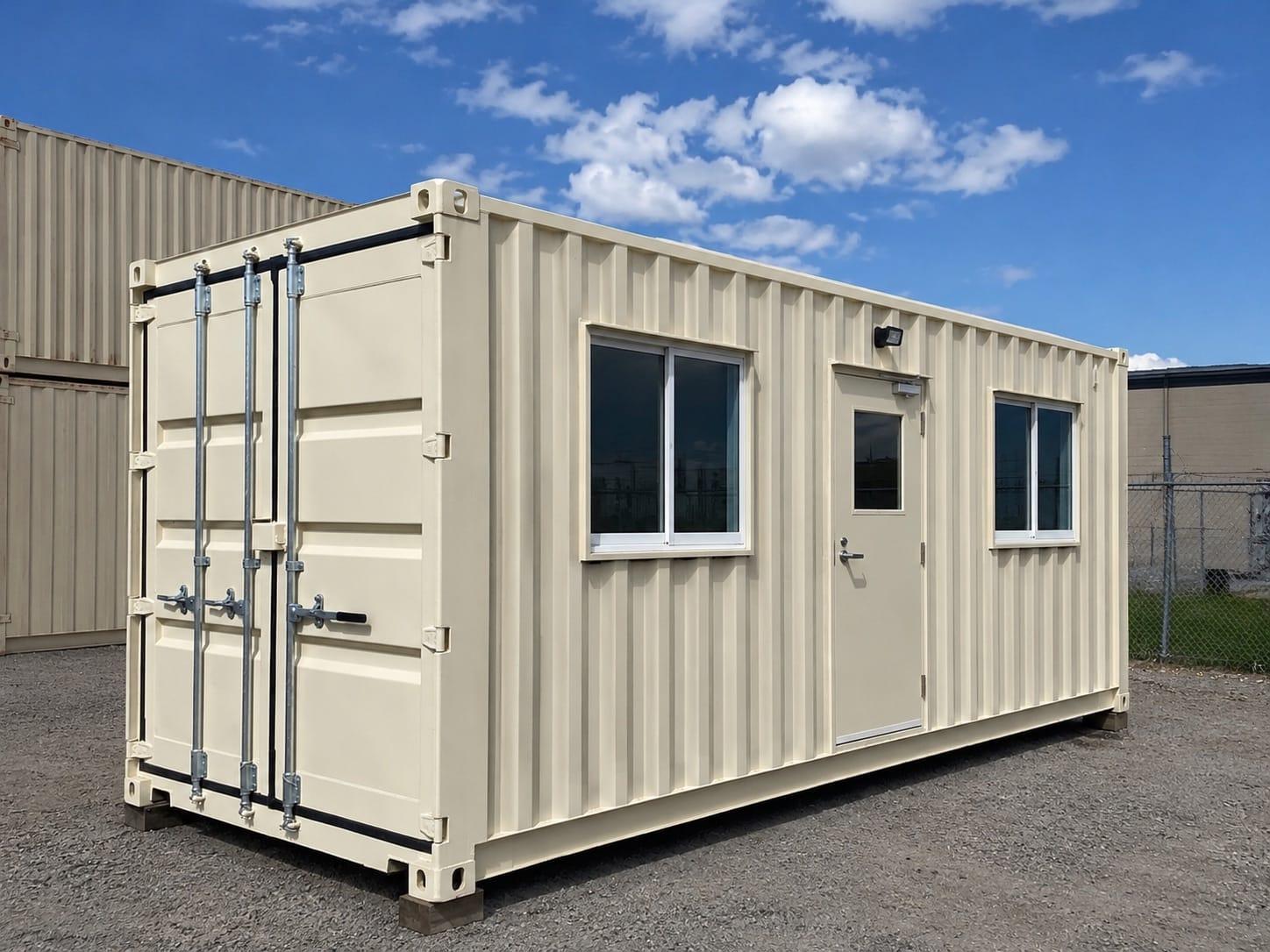
Custom 20ft shipping container site office with two sliding windows and a steel personnel door, built by Valleyview Containers in Kamloops, BC

Custom Solutions

Custom container solutions, built in Kamloops

Custom containers for work and for living: site offices, workshops, farm storage, cold storage, pop-up shops, bunkies and turnkey container homes — designed around your project, built in our own yard and delivered anywhere in BC. Insulated site offices from $14,600 CAD; bunkies and modular homes are quoted per project.

FAQ

Frequently asked questions

About this guide

How much usable space is inside a 20ft compared with a 40ft container?

A standard 20ft measures about 19ft 4in long, 7ft 8in wide and 7ft 10in high inside, for about 1,170 cubic feet and roughly 150 square feet of floor. A standard 40ft has the same width and height but is about 39ft 5in long, for about 2,390 cubic feet and roughly 300 square feet of floor. The 160 and 320 square foot figures are the outside footprint, which is what counts for lot coverage.

How tall is a 40ft high cube inside?

About 8ft 10in. The 9ft 6in figure quoted for a high cube is its outside height, just as a standard container is 8ft 6in outside and about 7ft 10in inside. The door opening is about five inches lower than the ceiling on both, so a high cube’s door is about 8ft 5in high. Measure your tallest item and add six inches to check it clears the door, not just the ceiling.

Which inspection checks matter most on a used container?

The doors and seals, the roof and seams, and the floor are the non-negotiable checks on a used cargo-worthy unit. Stand inside with the doors shut and look for daylight around them, which means a leak. Look up for pinholes in the roof, which show as bright dots. Walk the floor for soft, swollen or oil-soaked boards; light staining is fine, but rot or sagging is not. Then check the corner castings, the rust and the unit number.

What do the corner castings tell me about a container’s condition?

Whether it has been dropped or hit hard. A container has eight corner castings, which are how it is lifted and stacked, and the bottom four are where it bears its weight on your blocks or pad. They should be straight, square and free of major rust or impact damage. A bent corner means the unit was dropped, and that is a reason to walk away from that unit and look at another.

Should a chemical smell inside a used container worry me?

It depends on what the container is for. A chemical or pesticide odour can rule a unit out for food, residential or other sensitive storage, so note it before you buy. The plywood in most container floors is treated with insecticide and fungicide at the factory as a quarantine requirement. For dry storage of tools or equipment that matters less, but for food, feed, animals or living space, plan to cover the floor properly or replace the deck.

Container flooring guide
Concrete piers, a gravel pad or a concrete slab: which foundation suits my container?

It depends on how long the container stays and what it is for. A level, compacted gravel pad drains well, gives a level surface and is a cost-effective setup for storage. Concrete piers lift the container so air can move underneath, which helps keep moisture off the steel. A concrete slab suits permanent installations and heavy use. A home or other occupied build sits on whatever foundation its engineered drawings call for, and local rules can apply, so check first.

Do I need to mark utility lines before my container is delivered?

Yes. Find out where any buried lines run near the drop spot and along the truck’s path, and mark them before delivery day so the pad, blocks and truck can be kept clear of them. Overhead lines matter too, because the truck needs clear space above its whole path and a high cube rides about a foot higher on the deck. If a line is in the way, choose another spot before booking.

Besides the container itself, what should I budget for?

Delivery, site preparation, any modifications and any local permit fees, plus tax. Delivery is quoted separately by distance and site access, and the delivery quote is free. Site preparation, such as a gravel pad, blocks or piers, is the buyer’s part. Modifications like doors, windows, insulation and vents are added to the container price as quoted line items. If a permit is required, its fees are set locally and are not part of Valleyview’s quote.

Where can I see current prices for the containers in this guide?

On the products page, where each container shows its listed price range in Canadian dollars, plus tax and delivery. Listed prices can change, and the final price varies with colour, condition and where the unit is sourced, so the figure that counts is the one on your quote or invoice. A quote adds delivery to your address, so you see the all-in price before you commit to anything.

See container prices
Can two containers be joined into one larger room?

Yes, but it is structural work. Cutting out the wall between adjacent containers removes steel that holds the structure up, so the opening needs reinforcement, and it is one of the modifications Valleyview can quote. Large openings and joined units can also change how your local government reviews the project, so describe the plan to them before you commit. Joined homes are usually set by crane rather than tilt-deck, so share the layout when you ask for a quote.

Where should windows go when I modify a container?

On the wall where you want the light and the view, and clear of the corner posts. You choose which wall each opening lands on before anything is cut, because moving a hole in steel afterwards is a big job. If the container will be insulated, settle every window and door position first, since cutting an opening after the foam is sprayed means cutting through your own vapour barrier.

What kinds of vents can be added to a shipping container?

Passive whirlybird vents, louvred wall vents and powered exhaust are the usual options, and Valleyview quotes vents per design. Vents matter most on a container that sees big temperature swings, because they help keep condensation from damaging what is stored inside. On the coast, where humidity is the main problem, passive vents still help even in an insulated container. Tell Valleyview what you are storing and whether the container will be heated.

Does Valleyview deliver outside the communities listed in this guide?

Yes. Valleyview delivers across British Columbia from its Kamloops yard, including Metro Vancouver, the Fraser Valley, the Sea-to-Sky, the Sunshine Coast and Vancouver Island, as well as the Okanagan, Kootenays, Cariboo, Northern Interior and Peace Country. Vancouver Island, Sunshine Coast and Gulf Island deliveries are ferry-served. Delivery is quoted by distance and site access, so if your community is not listed, call (778) 694-4050 with your address.

How much room does the delivery truck need to reach my site?

For a 20ft container, allow 72 feet of clear length in a straight line, including the spot where the container will sit, at least 10 to 12 feet of width through gates, driveways and paths, and 16 feet of overhead clearance free of wires, branches and overhangs. The landing spot needs to be firm and level, because the container slides off the tilted deck onto it. A 40ft needs at least 110 feet of straight, clear length and more overhead room, so ask for the height your site needs when you book.

Watch the delivery video
Can I run this inspection checklist on a container at Valleyview’s yard?

Yes, for units that are in the yard. The inventory page lists the containers physically in the yard at D3-1764 Kelly Douglas Rd in Kamloops, open seven days a week from 10:00 AM to 6:00 PM. Call (778) 694-4050 to arrange a time and check the unit has not sold. If you cannot visit, ask for the condition notes and photos, and run the same checks on delivery day before you sign the delivery receipt.

See the yard inventory

Sizes & specs

What size container works for tractors and farm equipment?

For tractors and other tall machinery, look at a 40ft high cube first, because the door opening decides what drives in: about 8ft 5in on a high cube against about 7ft 5in on a standard container. Measure the tallest point and add six inches, and check the width, including mirrors and any loader, against the interior width of about 7ft 8in. For feed, tools and parts, the catalogue lists used 20ft and 40ft standard containers for farm and acreage storage.

How much does an empty shipping container weigh?

Published figures put an empty 20ft standard container at about 5,070 lb (roughly 2,300 kg) and an empty 40ft standard at about 8,270 lb (roughly 3,750 kg). A high cube is a couple of hundred pounds heavier, which changes nothing about how you prepare the ground. These are general published figures, not a weighed unit. If the route to your site crosses a bridge, a culvert or a soft driveway, tell Valleyview when you ask for a quote so the delivery can be planned around it.

New & used containers

What do the grades “WWT” and “as-is” mean when comparing containers?

They are trade grades below cargo-worthy. WWT is a unit that is still wind and watertight but not certified for ocean shipping, and it usually shows more cosmetic wear. As-is means sold without any weather-tight promise; it may have a pinhole leak, a patched repair or a sticky door, so inspect it in person. Valleyview’s catalogue grades are new and used cargo-worthy, so ask what any other grade term on a quote or listing means.

Which condition grades does Valleyview sell?

The catalogue has two: new, with the 20ft and 40ft units sold as one-trip, and used cargo-worthy, plus a refrigerated container. Units in the yard inventory also show the condition recorded for that specific unit. Container grading isn’t governed by one universal standard, so if a quote or listing uses a term you don’t recognize, ask Valleyview what it means for that unit before you buy.

Prices

What does a side-door shipping container cost?

A new 20ft side-door container is listed at $6,600–$9,000 and a new 40ft high cube side-door container at $9,000–$10,000, plus tax and delivery. Side-door units open along the full length of one wall, so you can reach any point inside without moving other things, which suits tool and parts storage, workshops and retail setups. Tell Valleyview which size you need and the quote will price it with delivery to your site.

Buying & paying

How long is a container quote valid for?

Quotes are typically valid for 30 days from the date they’re issued, unless the quote states otherwise. Prices are in Canadian dollars and can change, so if your quote has lapsed, ask for an updated one before you order. Final pricing is the figure confirmed on your current quote or invoice.

What information should I include in a container quote request?

Give your name, email and phone number, the container type you want, the delivery town or address, and your timeline. The quote form asks for your contact details and the container type, and the message box is where your delivery location, timeline and anything else go: how many units, a colour preference, or doors, windows and other modifications. If access to your site is tight, say so, and Valleyview can advise from a photo before you order.

Delivery

Can you deliver a container in winter or when there’s snow?

Winter delivery depends on the roads and your site, and the date is agreed when you order. Frozen ground can make some sites easier to reach, and remote sites are planned around seasonal access windows. Snow, ice and road conditions can still move a date, and Valleyview’s terms exclude liability for weather delays. Clear snow from the path and drop spot, and pick a spot that stays firm and dry after the thaw.

Preparing your site

Can I set a shipping container directly on dirt or grass?

It can, if the ground is firm and level, but for long-term placement Valleyview recommends a simple foundation. A compacted gravel pad keeps the steel frame out of the mud and lets water drain away, and blocks under the corners lift the frame so air moves underneath, which reduces the risk of rust. If the spot is soft or holds water after rain, choose firmer ground or call Valleyview before delivery day.

Owning a container

Why won’t my container lock or doors open in winter?

Check two things first. Moisture can work into the lock cylinder and freeze it, so give the lock a shot of graphite or a dry silicone lubricant in the fall rather than heavy oil, which collects grit. If the doors bind, check whether frost or the spring thaw has shifted the container out of level, because a twisted frame makes the doors hard to open and close.

Permits & bylaws

What changes can turn a storage container into a structure that needs a building review?

Stacking containers, adding a roof or lean-to, and cutting large openings can each move a container from storage toward being reviewed as a structure. Cutting removes structural steel, so openings need proper reframing. A container treated as a structure can bring footings, anchoring designed for wind and seismic loads, and a snow load review for an added roof or stacked units. If you plan any of these, ask your local government what review applies before the work starts.

Custom builds

What insulation options are there for a shipping container?

Valleyview’s menu has four: rigid foam board, closed-cell spray foam, rock wool and fibreglass batts, plus closed-cell foam sprayed under the floor for cold and frost-heave sites. Rigid foam is marked as the default for offices and workshops, and closed-cell spray foam is the recommendation for space occupied year-round in the North, with the highest R-value on the menu and a full air seal. Rock wool is fire-resistant and dampens sound. Fibreglass batts are fitted only on request.

Business & lease-to-own

Can a farm or ranch buy containers on lease-to-own or in bulk?

Yes. A farm or ranch can buy outright, spread the cost across the seasons with lease-to-own on a 20ft or 40ft container, or order several units at once with volume pricing, for example one for each yard or property. A plain container suits feed, seed and tools, and the farm and ranch storage build adds a personnel door and undercarriage insulation. Tell Valleyview about gates, creek crossings and bridge ratings on the way in so delivery can be planned.

Farm and ranch containers

Refrigerated containers

What happens to a reefer if the power goes out?

The refrigeration unit only holds your set temperature while it has power. The foam-filled walls help limit temperature swings, but how long the inside stays cold depends on the load, the set point and the weather, so plan for outages before you load product that can’t be allowed to warm up. Temperature monitoring can be added, quoted per design, so you know whether the box held overnight.

Uses

Can I run a pop-up shop, café or vendor bar out of a shipping container?

Yes. Valleyview’s pop-up package starts from a new one-trip 20ft, whose clean walls take paint well, and adds a personnel door, two sliding windows, steel stud framing, rigid foam and a basic electrical rough-in. Serving windows, counters, awnings, plumbing rough-in and branding are quoted per design, and espresso machines or commercial fridges need their own circuits. If you’ll sell food or drink, check with your regional health authority as well as your local government, which decides zoning and business licences, before ordering.

Pop-up retail containers

Still have a question? Call (778) 694-4050 or see the full FAQ.