
Container Modifications
How to Insulate a Shipping Container in BC
A sea can is a sealed steel box, and steel is the best condensation machine ever built. Here is what actually works to warm one up in the BC climate.
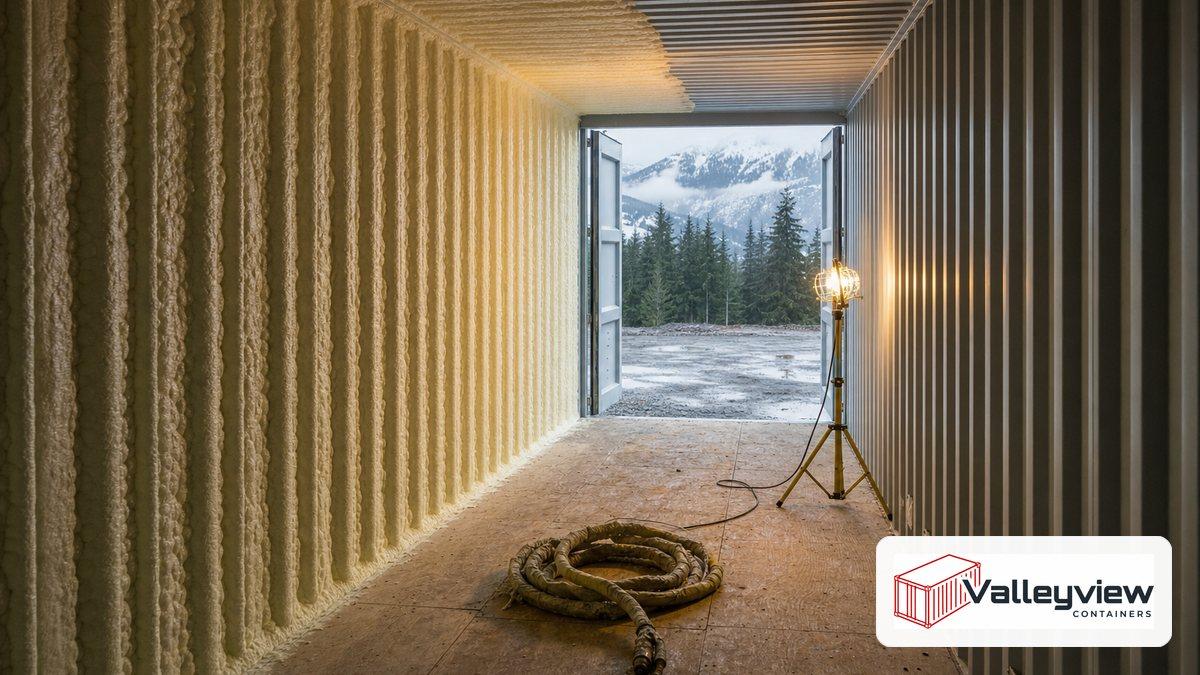
Short answer: for almost every container in British Columbia, closed-cell spray foam applied straight to the inside of the steel is the right choice. It insulates and stops moisture in one pass, it follows the corrugations instead of leaving voids behind them, and it does the one thing a steel box needs most — it keeps warm, damp interior air from ever touching a cold wall. Rigid foam board is a workable second option. Fibreglass batt, the cheapest material by a wide margin, is the one that gets people into trouble.
We sell containers to people converting them into workshops outside Kamloops, heated tool cribs on Interior job sites, and hobby shops on acreages in the Cariboo. Insulation is the question that comes up right after delivery, and it is worth understanding before you spend money, because the wrong method in a steel box does not just underperform — it traps water against the wall you were trying to protect.
Why a steel box is different from a shed
Two things make a container behave unlike any wood-framed building you have insulated before.
The first is condensation, sometimes called container rain. Warm air holds more moisture than cold air. When the humid air inside a container — from your breath, a propane heater, wet gear, or damp ground — reaches a ceiling panel that is sitting at 2°C on a February morning, the moisture drops out of the air onto the steel and runs, or drips. That happens whether or not the container leaks, which is why people are so often convinced of a roof leak that no amount of inspection finds.
The second is thermal bridging. The container is a continuous steel shell welded to a heavy steel frame, and steel conducts heat roughly a thousand times better than the foam you are putting against it. Anywhere insulation stops, or anywhere framing is fastened directly to the shell, heat runs straight out and that spot becomes cold enough to sweat. Insulation in a container needs to be continuous far more than it needs to be thick.
The three ways to insulate a container
| Method | Typical R-value per inch | Fits the corrugations? | Best for |
|---|---|---|---|
| Closed-cell spray foam | About R-6 to R-7 | Yes — sprayed directly to steel | Heated shops, offices, anything year-round |
| Rigid foam board | Roughly R-5 to R-6 | No — needs furring or spray-foamed seams | DIY builds, budget conversions |
| Fibreglass or mineral wool batt | Roughly R-3.5 to R-4 | No — requires a full stud wall | Rarely the right call in a sealed steel box |
What the table does not show
- Spray foam is also the vapour barrier. At the thicknesses used in a container, closed-cell foam is its own air and moisture barrier, bonded to the steel with no gap. There is nowhere for humid air to get behind it, so there is nowhere for it to condense. That, not the R-value, is the real reason it wins here.
- Rigid board lives or dies on the seams. Boards sit flat while container walls are corrugated, so you either fur out to the high points and accept dead air behind, or you glue board to the flats and seal every joint and edge with canned foam and tape. Done carefully it performs well; done quickly it becomes a condensation trap.
- Batt needs a stud wall you did not want. Framing eats several more inches of an already narrow box, the studs bridge to the steel, and fibreglass is porous — any interior air that finds its way behind it hits cold steel and wets the insulation. Wet fibreglass loses most of its R-value and stays wet.
- Spray foam is a hire, not a weekend. It calls for a licensed installer with the right equipment, ventilation, and protective gear. Budget for the trade, not just the material — and get it done before you build interior walls, wiring, or shelving.
Insulate the ceiling first
If your budget only stretches so far, spend it overhead. The roof is the coldest surface at night, it is the largest uninterrupted panel, and it is the one that drips on your contents. A container roof also has shallow support beams running across it, so ceiling insulation has to be continuous over those beams or every beam becomes a cold stripe.
Walls come next. The floor comes last, and it is the awkward one: container floors are usually thick plywood on steel cross-members, and once the unit is set on blocks you cannot easily get underneath. The practical approach is rigid board plus a plywood subfloor laid on top, which works well but costs you headroom you may not have. If you are touching the deck anyway, our guide to shipping container floors in BC covers what the original plywood is and whether to seal, overlay or replace it first.
Continuous beats thick
Two inches of foam covering every square inch of steel will outperform four inches with gaps at the beams, corners, and door frame. In a container, the cold spot you missed is where all the water shows up.
The space you give up
This is the trade-off nobody mentions until the walls are in. A standard container is about 7 ft 8 in wide and 7 ft 10 in high inside. Put two inches of foam on both side walls and you are down near 7 ft 4 in of width; add two inches overhead plus strapping and drywall or plywood and your finished ceiling lands somewhere under 7 ft 6 in. Add an insulated floor and it drops further.
That is why we steer anyone insulating for an occupied space toward a high cube. The extra foot of exterior height — 9 ft 6 in instead of 8 ft 6 in — is the difference between a finished ceiling you stand comfortably under and one that feels like a crawlspace. A used 40 ft high cube is usually the cheapest headroom you can buy, and if you are still choosing a footprint our 20 ft versus 40 ft comparison walks through the sizing.
Coastal damp, Interior cold
British Columbia gives you two different versions of this problem depending on where the container sits.
On the coast and in the wet belt, the enemy is humidity, not temperature. Mild, saturated air for eight months of the year means condensation is a year-round issue and mould follows it. Sealing the envelope matters more than piling on R-value, and passive vents still help — insulation slows heat transfer, but it does not remove moisture that is already in the box.
In the Interior and the North, the enemy is the swing. A container outside Prince George can run 30°C in July and well below freezing in January, and a container that is heated intermittently — warmed up for a Saturday in the shop, then left — cycles through the dew point every time. Intermittent heating is harder on a container than no heating at all, which is another argument for foam that seals rather than insulation that merely fills.
Two related notes. If you are simply storing gear and never heating the space, you do not necessarily need a full insulation job: ceiling foam or an anti-condensation treatment plus a pair of vents solves most drip complaints, and our maintenance guide covers the airflow side. And if what you actually want is an already-insulated box, a refrigerated container arrives from the factory with several inches of foam built into its walls, floor, and ceiling — see our guide to reefer containers in BC.
Planning an insulated container in BC
Order of operations saves money here. Decide on the end use first, buy the container that suits it, then insulate, then finish. Cutting a window or a man door after the foam is sprayed means cutting through your own vapour barrier, so plan the openings up front — that is part of what we sort out in our container modification work, and the modified container guide covers what else is worth doing at the same time. One more thing worth checking early: once a container becomes a heated, occupied structure rather than storage, your municipality may treat it as a building, with permits and code requirements attached. A quick call to your local building department before you start is far cheaper than a correction afterward.
Ready to pick a unit? See what is on the ground right now in our current inventory, compare heights and configurations across the full product range, or if you are in the Thompson-Nicola we deliver throughout Kamloops and the surrounding valley.
Custom Solutions
Custom container solutions, built in Kamloops
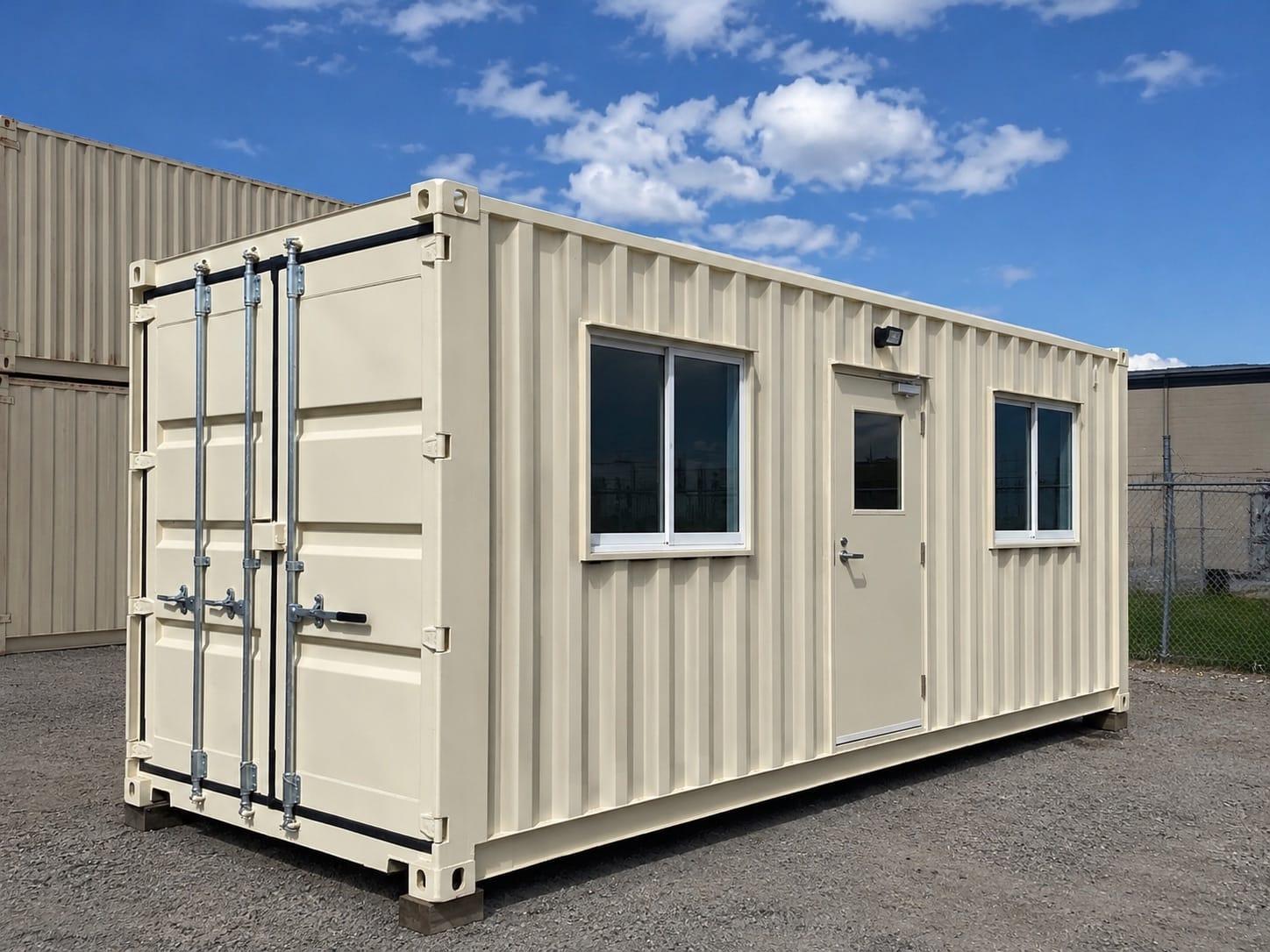
Custom containers for work and for living: site offices, workshops, farm storage, cold storage, pop-up shops, bunkies and turnkey container homes — designed around your project, built in our own yard and delivered anywhere in BC. Insulated site offices from $12,350 CAD; bunkies and modular homes are quoted per project.