
Frequently Asked Questions
Everything you need to know about buying and owning a shipping container in BC.
Every buyer question, by topic
Sizes, condition, prices, ordering, delivery, site prep, permits, ownership, custom builds and lease-to-own.
Sizes & specs
What are the dimensions of a 40ft shipping container?
A 40ft container is 40ft long and 8ft wide outside, and stands 8ft 6in tall in standard height or 9ft 6in as a high cube. Inside, a standard 40ft measures about 39ft 5in long, 7ft 8in wide and 7ft 10in high, for roughly 2,390 cubic feet. A 40ft high cube has the same length and width with about 8ft 10in of interior height, for roughly 2,690 cubic feet.
Will a car, quad or side-by-side fit in a shipping container?
It depends on the vehicle, so measure it first. Compare its length with the interior length, about 19ft 4in in a 20ft or 39ft 5in in a 40ft. Compare its height, including any trailer it sits on, plus six inches for the ramp angle, with the door opening: about 7ft 5in on a standard container or 8ft 5in on a high cube. Compare its width, mirrors included, with the interior width of about 7ft 8in, and ask Valleyview to confirm the door opening width.
Can I get a 20ft high cube container?
Not as a catalogue item: Valleyview lists every 20ft at the standard 8ft 6in height. High cube 20ft containers exist, but they are uncommon in Canada and usually cost disproportionately more, so most 20ft units on the ground are standard height. If you need the extra foot of headroom, the 40ft high cube is the common tall unit. If your project needs a 20ft high cube, call Valleyview to talk through the options.
What are the dimensions of a 20ft shipping container?
A 20ft container is 20ft long, 8ft wide and 8ft 6in tall outside. Inside, a standard 20ft measures about 19ft 4in long, 7ft 8in wide and 7ft 10in high, for roughly 1,170 cubic feet, and the door opening is about five inches lower than the ceiling. On the ground it takes up roughly the space of a single-car garage. Double-door, side-door and refrigerated 20ft units share the same outside size, though the refrigerated unit has less room inside because of its insulation.
Can I stack pallets two high in a shipping container?
In a high cube, usually yes; in a standard-height container, usually not. A loaded pallet at a typical four-foot build height stacks two high at roughly 8 feet, which clears a high cube’s interior height of about 8ft 10in but not a standard container’s 7ft 10in. Check the door opening for your forklift too, about 8ft 5in on a high cube, and plan rows around the interior width of about 7ft 8in.
How much does an empty shipping container weigh?
Published figures put an empty 20ft standard container at about 5,070 lb (roughly 2,300 kg) and an empty 40ft standard at about 8,270 lb (roughly 3,750 kg). A high cube is a couple of hundred pounds heavier, which changes nothing about how you prepare the ground. These are general published figures, not a weighed unit. If the route to your site crosses a bridge, a culvert or a soft driveway, tell Valleyview when you ask for a quote so the delivery can be planned around it.
How many square feet is a shipping container?
A 20ft container gives about 150 square feet of usable floor inside and covers 160 square feet of ground outside. A 40ft, standard or high cube, gives about 300 square feet inside and covers 320 square feet. A 10ft covers 80 square feet. Use the outside area for lot coverage and the outside length and width for setbacks when you check with your local government, and the inside figure when you plan shelving, pallets or a layout.
How wide is a shipping container inside?
About 7ft 8in. Apart from the refrigerated unit, Valleyview’s 20ft and 40ft containers are 8ft wide outside and about 7ft 8in wide inside, standard height or high cube, because a high cube only adds height. The refrigerated unit has less room inside because of its insulation. If a load is too wide to go in through the end doors, a taller box will not help: a side-door unit lets you load it from the long side, or two containers can be set apart with a roof between them.
How do I know if my items will fit through a container’s doors?
Compare your tallest item with the door opening, not the ceiling. The opening is about five inches lower than the interior height: roughly 7ft 5in on a standard container and 8ft 5in on a high cube. Measure the tallest item, add six inches for forklift tines or a ramp angle, and pick the container that clears that number. Interior width is about 7ft 8in; ask Valleyview to confirm the door opening width on the unit you are buying.
What kind of doors does a standard shipping container have?
A standard container has a pair of steel cargo doors at one end, with the hinges welded to the frame, and both doors should swing and lock cleanly. The door opening is about five inches lower than the interior ceiling. If you need access from both ends or along the side, look at a double-door or side-door container, or ask about cutting in a man door or roll-up door as a modification.
Should I buy one 40ft container or two 20ft containers?
One 40ft suits a site with room for it and a need for one large space; two 20ft containers suit tighter or split sites. The 40ft gives about 2,390 cubic feet in one open run, slightly more than two 20ft units at about 2,340, with no wall in the middle and four corners to level instead of eight. Each 20ft needs less delivery room and is easier to move later. Compare delivered quotes for both.
20ft vs 40ft guideWhat is the difference between a high cube and a standard container?
A high cube is one foot taller: 9ft 6in outside instead of 8ft 6in, with about 8ft 10in of interior height instead of about 7ft 10in. It is not longer or wider, so it sits on the same footprint and needs the same level, well-drained ground. High cubes are built to the same ISO standards from the same CORTEN steel, and a 40ft high cube holds about 2,690 cubic feet against about 2,390 for a standard 40ft.
High cube vs standardDo I need a high cube, or will a standard-height container do?
Choose a high cube if you will stack pallets two high, build tall shelving, store tall equipment, insulate the box or work standing up inside it. A standard height usually does the job for low items such as totes, tools, tires and furniture. It also suits sites with tight overhead clearance, because a high cube rides about a foot higher on the delivery truck, and small lots where a lower profile matters. Some local governments regulate the height of accessory structures, so check before you order.
How do I measure my site for a shipping container?
Start with the footprint: mark a rectangle 8ft wide and as long as the container, plus clear space at the door end to swing the doors open and load. Check the spot is level, firm and drains well. For a 20ft, the truck needs about 72 feet of straight, clear length ending at the container’s final spot, at least 10 to 12 feet of width and 16 feet of overhead clearance; a 40ft needs at least 110 feet and more overhead room, so ask for the height your site needs. Photos of the spot and approach help Valleyview advise before you order.
Watch the delivery guideAre new 40ft containers standard height or high cube?
In Valleyview’s catalogue, every new 40ft container is a high cube, 9ft 6in tall, including the 40ft high cube with side doors. A standard-height 40ft at 8ft 6in is listed as a used, cargo-worthy unit, and a used 40ft high cube is listed as well. All four share the same 40ft by 8ft footprint, so the choice comes down to headroom, condition and budget.
How much headroom is left after insulating a shipping container?
In a standard-height container, expect a finished ceiling somewhere under 7ft 6in. A standard box starts at about 7ft 10in high and 7ft 8in wide inside; insulation, strapping and a ceiling can take six inches or more of headroom, and two inches of foam on each side wall brings the width close to 7ft 4in. A high cube starts at about 8ft 10in, which is why Valleyview steers insulated, occupied spaces toward one.
Insulating a containerWhat is a double-door (tunnel) container used for?
A double-door or tunnel container has full cargo doors at both ends, so you can load and unload from either end without climbing over stored items to reach the back. It suits storage you get into often, such as high-turnover inventory, drive-through or pass-through layouts, long items loaded from both ends, and job-site staging. In Valleyview’s catalogue it is a new 20ft unit with the same outside size as a standard 20ft.
See the double-door 20ftWhat size container fits a small or tight job site?
Usually a 20ft, or a 10ft where a 20ft will not fit. A 20ft holds the tools and equipment for a specific job, needs less delivery room than a 40ft and is easier to move to the next site. A 10ft has half the footprint of a 20ft, though supply is limited. A 20ft double-door unit opens at both ends, which helps with job-site staging. A 40ft only makes sense where the truck has room to reach the spot.
What sizes of shipping containers does Valleyview Containers sell?
Valleyview sells 10ft, 20ft and 40ft shipping containers. The 10ft is sold new. The 20ft comes new or used with standard end doors, new as a double-door or side-door unit, and as a refrigerated unit. The 40ft comes as a new high cube, a new high cube with side doors, or used in standard or high cube height. Every size is 8ft wide outside, and the products page lists dimensions and prices for each.
Compare all containersWhat size container works for tractors and farm equipment?
For tractors and other tall machinery, look at a 40ft high cube first, because the door opening decides what drives in: about 8ft 5in on a high cube against about 7ft 5in on a standard container. Measure the tallest point and add six inches, and check the width, including mirrors and any loader, against the interior width of about 7ft 8in. For feed, tools and parts, the catalogue lists used 20ft and 40ft standard containers for farm and acreage storage.
How big is a 10ft shipping container and what fits in it?
A 10ft container is 10ft long, 8ft wide and 8ft 6in tall outside, about half the footprint of a 20ft, with roughly 560 cubic feet inside. That holds about the contents of a one-bedroom apartment, a motorcycle plus gear, or a contractor’s tools and materials, and suits tight lots and small job sites. Valleyview’s catalogue lists the 10ft as a new container only, and supply is limited, so availability is confirmed with your quote.
When does a side-door container make sense?
A side-door container makes sense when you need to reach any point inside without moving everything else. Its doors open along the full length of one wall, which suits tool and parts storage on shelving, workshops that need wide entry, retail, market and pop-up conversions, and awkward loads that will not go in through an end door. Valleyview lists it as a new 20ft and as a new 40ft high cube.
What size container do I need for household storage?
As a rough guide, a 10ft (about 560 cubic feet) holds the contents of a small one-bedroom apartment, a 20ft (about 1,170 cubic feet) a one- to two-bedroom apartment, and a 40ft standard (about 2,390 cubic feet) roughly a three- to four-bedroom house. List what you are storing, measure the largest pieces, leave room to walk in and reach things, and if you are between two sizes, choose the larger one.
How much weight can a shipping container hold?
Valleyview’s catalogue lists a maximum payload of 10,000 kg for a 10ft, 25,000 kg for a 20ft and 28,600 kg for a 40ft, standard or high cube. These are catalogue figures rather than the rating of a specific unit, so mention any unusually heavy load when you ask for a quote. On a standard dry container the floor is plywood or bamboo over steel cross-members, and it carries things like pallet racking, a welder, a quad or a pallet jack.
New & used containers
How does Valleyview inspect a container before selling it?
Each container is checked against a set list before sale: the doors and seals, looking for daylight around the gaskets; the roof and seams for pinholes; the floor for soft, swollen or soaked boards; the corner castings for bends or impact damage; exterior rust; and the CSC plate and unit number. Valleyview then gives an accurate condition description, so ask for the notes on any unit you’re quoted. You can run the same checks yourself when you look at a unit.
What should the floor of a used container look like?
Solid underfoot, with no soft, swollen, sagging or rotted boards. Light surface staining is normal on a used deck; walk the full length, bounce on it, and look for dark rings that point to a past leak. Note any chemical or pesticide smell, which can rule a unit out for food, residential or sensitive storage. Valleyview will describe the floor of a container on its list before you commit.
Container flooring guideWhat do the grades “WWT” and “as-is” mean when comparing containers?
They are trade grades below cargo-worthy. WWT is a unit that is still wind and watertight but not certified for ocean shipping, and it usually shows more cosmetic wear. As-is means sold without any weather-tight promise; it may have a pinhole leak, a patched repair or a sticky door, so inspect it in person. Valleyview’s catalogue grades are new and used cargo-worthy, so ask what any other grade term on a quote or listing means.
Do new and used containers come with a warranty?
New containers come with a manufacturer’s warranty for structural integrity and watertight condition; ask Valleyview to confirm the details for your unit with your quote. Used containers are sold without a warranty, except as required by law, and normal wear from a working life is expected. Valleyview’s terms call this an as-is sale, which is about the warranty, not the as-is condition grade. Each container is inspected and given an accurate condition description, so read it before you commit.
What does “cargo-worthy” mean on a used container?
Cargo-worthy, often shortened to CW, means the container has been inspected and judged structurally sound and watertight enough to carry cargo by sea. It has been in shipping service, so expect surface rust and cosmetic dents, but no holes, no soft floor and doors that seal. Valleyview’s catalogue lists its used 20ft, 40ft and 40ft high cube containers as cargo-worthy.
How old is a used shipping container?
It varies from unit to unit. A used container has typically spent years in shipping service, while a one-trip container’s manufacturer’s plate is usually only a year or two old. For storage, condition matters more than age: tight seals, a solid floor and only surface rust count for more than the build date. If age matters to you, ask for the details of the specific unit with your quote.
Can I choose the colour of a used container?
Not from the catalogue. A used container comes in whatever colour it wore in service, usually with some fading, so check the photo on a yard listing or ask what colour a unit is. If you need a particular colour, a container can be repainted in a RAL colour you choose before delivery, quoted per design, or you can choose a new 20ft in a factory RAL colour.
Custom paint and decalsWhat does “one-trip” mean on a new container?
One-trip means the container was manufactured overseas, loaded once for a single voyage to North America, then sold. It is structurally new with minimal wear: straight walls, intact paint, tight door seals and a manufacturer’s plate only a year or two old. Valleyview’s new 20ft containers, including the double-door and side-door units, and its new 40ft high cubes are listed as one-trip.
Should I buy a new or used container to convert into an office or workshop myself?
For a conversion, lean toward a one-trip container or a strong cargo-worthy unit: when you’re cutting in doors, windows and insulation, straight walls and minimal rust give you a better base to build on. Check a used unit’s walls, roof and floor closely before you start. A one-trip deck is new and unstained, but either way, seal or cover the factory-treated floor before anyone works in the space. If Valleyview does the build instead, the base container is confirmed with your custom quote.
Custom container buildsHow do I check a container’s door seals before I buy it?
The doors should swing freely, latch firmly and press evenly against the rubber gaskets all the way round, and any daylight around a closed door means water can get in. Look along the gaskets for cracks or tears, and check that the hinges turn without grinding. Valleyview checks that door seals are intact before sale, so if a seal or door on a specific unit worries you, raise it before you commit.
What’s the difference between a new and a used shipping container?
A new one-trip container has made a single loaded voyage from the factory, so it arrives with straight walls, intact factory paint, tight door seals and an unstained floor. A used container has been in shipping service and shows it, with surface rust, dents and faded paint. Valleyview’s catalogue lists its used units as cargo-worthy, and containers are inspected before sale. New costs more; used suits storage where cosmetic wear doesn’t matter.
Will a used container still have faded paint and old markings?
Expect faded paint. A used container has had a working life, and paint wear is cosmetic: it doesn’t affect whether the container keeps your contents dry. Markings vary from unit to unit, so check the photo on a yard listing or ask Valleyview about a particular container. If you want old markings covered, existing containers can be repainted and re-decaled, quoted per design; ask about it with your quote.
Should I buy a new or used container for storage?
For most storage, a used cargo-worthy container makes sense: it is inspected, wind and watertight and costs less than new, and cosmetic wear doesn’t affect what you keep inside. A useful rule is to buy the lowest grade that still keeps your contents dry. Choose new when looks matter, such as a customer-facing business or a branded unit, or when you want minimal rust from the start.
Compare containersWhat does “wind and watertight” mean?
It means the shell keeps weather out: no daylight through the walls or roof, and no leaks at the roof, seams or door seals. Valleyview inspects its containers for wind and watertight condition before sale. It does not mean the inside stays dry in every season, because condensation can form on the steel when temperatures swing, even in a container with no leaks. Vents, desiccants or insulation help with that.
Are dents on a used container a problem?
Usually not. Dents in the walls of a cargo-worthy container are cosmetic and expected after years of service; what matters is no holes, doors that close and seal, and a solid floor. Look harder at the corner castings, which are how a container is lifted and stacked, and at the corner posts. A bent corner suggests the unit was dropped, so ask about it before you buy.
Which grade should I buy if I might sell the container or ship it overseas later?
If you might ship it overseas one day, stick to one-trip or cargo-worthy, the two grades that still carry cargo, and ask whether the specific unit has a CSC plate, which international shipping requires. No one can promise what a container will be worth later, so buy for the job in front of you. Whatever the grade, a container kept on a level, well-drained pad, with its rust treated and its door seals cared for, stays in better shape.
Which condition grades does Valleyview sell?
The catalogue has two: new, with the 20ft and 40ft units sold as one-trip, and used cargo-worthy, plus a refrigerated container. Units in the yard inventory also show the condition recorded for that specific unit. Container grading isn’t governed by one universal standard, so if a quote or listing uses a term you don’t recognize, ask Valleyview what it means for that unit before you buy.
What is a shipping container floor made of?
A standard container floor is a deck of marine-grade plywood about 28 mm (1 1/8 inches) thick, screwed to steel cross-members that run side to side about a foot apart. It is traditionally dense tropical hardwood plywood, and newer units increasingly use bamboo or a bamboo-hardwood composite. The deck is treated with insecticide and fungicide at the factory, so for food storage or living space, cover it properly or replace it.
How much rust is normal on a used container?
Surface rust is normal on a used container and is cosmetic, not structural. A used 20ft with one or two rust patches the size of your palm is fine; a unit covered in scale is not. Bubbling rust, scale rust or rust that flakes off in sheets is eating into the steel, so look closely at the bottom rails, corners and roof before you buy, and ask about any heavy rust on a specific unit.
What colours can I get on a new shipping container?
New 20ft containers can be ordered in a range of standard factory RAL colours, such as RAL 7035 Light Grey, RAL 9010 Pure White, RAL 7016 Anthracite Grey, RAL 6007 Bottle Green and RAL 5010 Gentian Blue, and other RAL colours are available on request. Price varies by colour, so ask for current options when you request a quote. For other new sizes, ask which colours are available.
Does a used container come with a CSC plate or certificate?
Don’t assume it does; ask about the specific unit. Cargo-rated containers carry a CSC plate at the door end and a unique unit number, and a container without a plate can’t be shipped internationally. For a container that will stay on your property for storage, a missing plate doesn’t stop it keeping contents dry, but it is worth knowing before you buy. Confirm what the unit has with your quote.
Can I see photos and condition notes for a container before I order?
Yes, for units in Valleyview’s yard. Each inventory listing shows a photo when one is available, the condition recorded for that unit and its unit number when legible, and you can ask for a fuller description of any unit before you commit. For a container sourced from a partner depot, ask what photos and condition details come with your quote, and read them before you order.
See the yard inventoryPrices
How much do doors, windows and insulation add to a container’s price?
Each adds its own line item to the base container price, using the rates on Valleyview’s published modification price list, and your itemized quote confirms the final figure. Doors and windows are priced per opening, so every extra one adds another line, while framing, insulation and the basic electrical package are each priced once per container. Heaters, plumbing and interior finishes depend on the design and are quoted per project.
Modification price listWhy are your container prices shown as a range instead of one price?
A range covers the differences between individual units of the same type. The final price varies with colour, condition and where a unit is sourced, so two containers of the same size and grade can be priced differently, and prices can change over time. Your quote or invoice confirms the final price for the container you order.
How much does a 20ft double-door container cost?
A new 20ft double-door container, also called a tunnel container, is listed at $4,600–$5,000 plus tax and delivery. It has full cargo doors at both ends, so you can load from either end and reach the back without climbing over stored items. For comparison, a new 20ft with doors at one end only is listed at $3,700–$4,200. Your quote confirms the price along with delivery to your site.
How much is a used 20ft shipping container?
A used 20ft container is listed at $2,500–$3,000 plus tax and delivery. It’s a cargo-worthy unit: it has been in shipping service, so expect surface rust and dents, but it’s inspected and wind and watertight before it leaves the yard. It gives about 1,170 cubic feet of lockable space for storage where looks don’t matter. Where a unit falls in the range depends on its condition and where it’s sourced.
What’s the lowest-priced shipping container you sell?
A used 20ft container has the lowest starting price in Valleyview’s catalogue, listed at $2,500–$3,000 plus tax and delivery. It has been in shipping service, so expect surface rust and dents, but it’s inspected and wind and watertight before it’s sold. Listed prices can change, so your quote confirms the final figure along with delivery to your site.
Does a 40ft container cost twice as much as a 20ft?
Not at Valleyview’s current listed prices: a 40ft is listed at less than twice the price of a 20ft in the same condition. A used 40ft is listed at $3,300–$3,600 against $2,500–$3,000 for a used 20ft, and holds about 2,390 cubic feet to the 20ft’s 1,170. A new one-trip 40ft high cube is listed at $6,200–$7,100 against $3,700–$4,200 for a new one-trip 20ft. All prices are plus tax and delivery, and a 40ft needs more room to deliver and place, so check that your site can take one.
Why don’t the units on your inventory page show a price?
Each yard unit is quoted as a delivered price for your address rather than shown with a sticker price. The inventory page lists only containers physically in Valleyview’s Kamloops yard, and choosing a listing starts a quote request for that unit. For a guide to what each size and condition costs, the products page shows listed price ranges in Canadian dollars plus tax and delivery.
Compare listed pricesWhat does a side-door shipping container cost?
A new 20ft side-door container is listed at $6,600–$9,000 and a new 40ft high cube side-door container at $9,000–$10,000, plus tax and delivery. Side-door units open along the full length of one wall, so you can reach any point inside without moving other things, which suits tool and parts storage, workshops and retail setups. Tell Valleyview which size you need and the quote will price it with delivery to your site.
How much more does a high cube cost than a standard-height container?
In used 40ft containers, a high cube is listed at $3,500–$4,000 against $3,300–$3,600 for standard height, a difference of $200 at the low end of each range, before tax and delivery. For that you get a foot of extra height and about 300 more cubic feet on the same footprint, with the same site preparation. The extra headroom suits tall equipment, palletized goods and workshops that need room to stand and work.
How much more does a new 20ft container cost than a used one?
A new one-trip 20ft is listed at $3,700–$4,200 and a used cargo-worthy 20ft at $2,500–$3,000, a difference of $1,200 at the low end of each range, before tax and delivery. Both hold about 1,170 cubic feet. The extra buys factory paint in a choice of RAL colours, minimal wear and a manufacturer’s warranty. The used unit shows surface rust and dents and is sold without a warranty except as required by law, but it’s inspected and wind and watertight before it’s sold.
Container condition gradesHow much does a 10ft shipping container cost?
A 10ft container is listed at $5,000–$5,500 plus tax and delivery. It has about half the footprint of a 20ft, for tight lots and small sites where a 20ft won’t fit. Smaller doesn’t mean lower-priced here: a new one-trip 20ft is listed at $3,700–$4,200, so if your site can take a 20ft, compare both. Because 10ft units are made by cutting and re-ending standard containers, they’re less common, so call (778) 694-4050 to confirm current availability before you plan around one.
How much does a used 40ft shipping container cost?
A used 40ft standard-height container is listed at $3,300–$3,600 plus tax and delivery, and a used 40ft high cube is listed at $3,500–$4,000. Both are cargo-worthy units, inspected and wind and watertight before they’re sold. The standard 40ft holds about 2,390 cubic feet, and the high cube, a foot taller, about 2,690. Delivery is quoted separately, and a 40ft needs more room on the route and at the drop spot than a 20ft.
What does a new 40ft high cube container cost?
A new one-trip 40ft high cube is listed at $6,200–$7,100 plus tax and delivery. It’s a foot taller than a standard container and holds about 2,690 cubic feet, with clean factory paint and a manufacturer’s warranty. If you also want full-length side access, the new 40ft high cube side-door container is listed at $9,000–$10,000. A high cube rides about a foot higher on the delivery truck, so check overhead clearance along the route to your drop spot.
What does a new 20ft shipping container cost?
A new one-trip 20ft container is listed at $3,700–$4,200 plus tax and delivery. One-trip means it was loaded once for a single voyage, so it is structurally new, with factory paint and minimal wear. New 20ft units come in a range of factory RAL colours, and pricing varies slightly by colour, so ask for the current colours when you request a quote.
Does a container cost more in some parts of BC than others?
The delivered price can differ by location. Part of a container’s price depends on where the unit is sourced, which is one reason listed prices are ranges, and delivery is quoted on the distance to your site and how easily the truck can reach it. Two buyers ordering the same size in different towns can therefore get different all-in quotes. Ask for a quote to your own address to get the figure for your site.
What costs aren’t covered by a Valleyview container quote?
Anything done by you, your trades or your local government. Preparing a level, firm site with clear access for the truck is the buyer’s part, so budget for any gravel pad, blocks or clearing. If a permit is required, its fees are set locally and are not part of Valleyview’s quote, nor are energy advisor, septic design or connection fees on a home or suite. Your electrician’s and plumber’s final connections are separate, and insurance is between you and your broker.
How much does a refrigerated shipping container cost?
The 20ft refrigerated container, or reefer, is listed at $27,000–$30,000 plus tax and delivery. It has insulated walls and a working refrigeration unit for cold or frozen storage. It needs 3-phase power on site, typically 460V, so also plan for a qualified electrician to install the outlet and wiring, or a diesel generator on an off-grid site. Confirm your electrical service before ordering; Valleyview can advise on the requirements.
Refrigerated container guideHow much does a shipping container cost in BC?
Listed prices for Valleyview’s non-refrigerated containers run from $2,500 to $10,000 in Canadian dollars, plus tax and delivery, depending on size, condition and door layout. A used 20ft is listed at $2,500–$3,000, a new one-trip 20ft at $3,700–$4,200 and a used 40ft at $3,300–$3,600. The highest-priced non-refrigerated unit is the new 40ft high cube side-door container, listed at $9,000–$10,000. The 20ft refrigerated container is listed separately at $27,000–$30,000. Your quote adds delivery to your site, so you see the all-in price before you commit.
Buying & paying
Do I need to give my exact address to get a quote?
No, your town or postal code is enough to start. Delivery is priced by distance and site access, so a quote can begin from your general location. Before you order, share the full address, or directions for a rural site without one, so the route in and the drop spot, including the ground, gates and overhead clearance, can be checked.
Can I reserve a container I see on your inventory page?
There’s no way to hold a unit online, but you can ask for that exact unit. Clicking a listing opens the quote form with that listing already named; add your delivery location and timeline, and Valleyview replies with a delivered price for your address. Listings can sell in the meantime, so call (778) 694-4050 if timing matters. An order is only confirmed once Valleyview accepts it and issues an invoice, and a deposit may be required to secure it.
What payment methods do you accept for a shipping container?
Valleyview’s listed payment methods are cash, cheque and bank transfer. The payment terms for your order, including any deposit and when the balance is due, are set out on your invoice, so confirm how you’ll pay when you accept your quote rather than on delivery day.
Can I buy a container through my business?
Yes. Companies, farms and other organizations can buy containers outright or on lease-to-own terms. Give the business name when you request a quote, and say whether your purchasing team or funder needs a particular quote format or billing arrangement, so it’s set up correctly from the start. Business buyers can ask for an itemized quote and a formal invoice, and the payment terms are set out on the invoice.
Containers for businessWhat paperwork do I get when I buy a container?
You get a quote (ask for it by email if you want it in writing), then an invoice or order confirmation once Valleyview accepts your order, and you sign a delivery receipt when the container arrives, noting any damage or discrepancies at that time. Business and project buyers can ask for itemized quotes and formal invoices. If you need a particular document, such as a certificate for a used unit, ask before you order rather than assuming it’s included.
Is a container quote free, and does asking for one commit me to buy?
Quotes are free, and requesting one does not commit you to anything. Under Valleyview’s terms, a quote is an invitation for you to make an offer to purchase, and an order is only confirmed once Valleyview accepts it and issues an invoice or confirmation. You can take time to compare sizes, check your site and confirm local rules with your municipality or regional district before you decide.
Read the termsCan I pay for a container monthly instead of all at once?
Yes, through lease-to-own, the only financing Valleyview offers. You make monthly payments on a 20ft or 40ft container, the payment, term and delivery are quoted together up front, and when the term ends the container is yours. Mention lease-to-own when you ask for a quote so it’s priced that way. Valleyview does not rent containers, so there are no rental or short-term options.
How lease-to-own worksDo I need to visit the yard to buy a container?
No. You can get a quote and place your order without coming to the yard, and the container is delivered to your site anywhere in BC. If you’re unsure whether the truck can reach your drop spot, send a photo of the access and get advice before you order. When the container arrives, you or someone you designate inspects it and signs the delivery receipt, noting any damage at that time.
What happens after I accept a container quote?
Valleyview confirms the order with an invoice or confirmation, and the delivery terms, costs and schedule are agreed then. A deposit may be required, with full payment typically due before delivery. Before the truck arrives, make sure the spot is level and firm with clear access. On delivery day, you or someone you designate meets the driver, confirms placement, inspects the container and signs the delivery receipt.
Watch the delivery guideI’m not sure which container I need. Can you help me choose before I order?
Yes. Tell Valleyview what you plan to store or build, how much space you have on site and your budget, and you’ll get a recommended size and condition. Choosing “Not Sure” as the container type on the quote form is fine. Before you call, measure the spot and your largest items, and walk the route the delivery truck would take, so the advice fits your site.
Can I buy a shipping container online?
Not through an online checkout. The website lets you request a quote, browse the yard inventory and design a custom build in the Container Studio, but there is no payment step on the site. Valleyview sends you a quote for the container and delivery; when you accept it, Valleyview confirms the order with an invoice or confirmation, and you pay under the terms set out there.
How do I find out whether the container size I want is available?
Check the live inventory page for units physically in the yard, then call (778) 694-4050 or send a quote request for anything you don’t see. The inventory updates as units arrive and sell, and Valleyview also sources containers from partner depots across Canada. The website can’t promise that a listed item is in stock, so availability is confirmed with your quote. 10ft units are less common, so confirm those before ordering.
Do I have to pay in full before the container is delivered?
Usually, yes. Under Valleyview’s terms, full payment is typically required before delivery unless other arrangements have been agreed in writing. Late payments may incur interest charges and can delay delivery, so plan to settle the balance before the delivery date you’ve arranged. If you need a different arrangement, raise it at the quote stage and get it confirmed in writing.
Can I get one quote for several containers?
Yes. On the homepage price list you can select more than one container and send them as a single quote request, or list each size, condition and quantity in your message or on the phone. If the units are going to different addresses, give each one, since delivery is quoted by distance and site access. Larger multi-unit orders are handled as fleet orders, with volume pricing and no fixed minimum.
Fleet and bulk ordersHow do I order a shipping container from Valleyview Containers?
Start by asking for a quote by phone at (778) 694-4050, by email at valleyviewcontainers@gmail.com, or through the quote form on the website. Say which size and condition you want and where it’s going, and Valleyview quotes the container and delivery to your address together. When you accept the quote, Valleyview confirms the order by issuing an invoice or confirmation, and delivery terms and scheduling are agreed at that point.
Request a quoteWhat information should I include in a container quote request?
Give your name, email and phone number, the container type you want, the delivery town or address, and your timeline. The quote form asks for your contact details and the container type, and the message box is where your delivery location, timeline and anything else go: how many units, a colour preference, or doors, windows and other modifications. If access to your site is tight, say so, and Valleyview can advise from a photo before you order.
What does a container quote from Valleyview include?
A quote prices the container and delivery to your address together, so you see the all-in price for both before you commit, with applicable GST and PST added. The delivery portion depends on distance and site access, which is why it’s quoted for your specific site rather than listed. If you add doors, windows, insulation or other modifications, each one is itemized line by line on the same quote, so you can see what every part of the job costs.
Where is Valleyview’s container yard, and what are your hours?
The yard and office are at D3-1764 Kelly Douglas Rd, Kamloops, BC V2C 5S4, open seven days a week from 10:00 AM to 6:00 PM. Call (778) 694-4050 during those hours. The units on the live inventory page are on the ground there, and containers are delivered across BC from this yard. To look at a particular unit, call ahead to arrange it and check it hasn’t sold.
How long is a container quote valid for?
Quotes are typically valid for 30 days from the date they’re issued, unless the quote states otherwise. Prices are in Canadian dollars and can change, so if your quote has lapsed, ask for an updated one before you order. Final pricing is the figure confirmed on your current quote or invoice.
Can I cancel a container order or return a container?
If you cancel an order before delivery, cancellation fees may apply. Containers are generally not returnable once delivered, and any return has to be approved in advance and may carry restocking fees and transportation costs. Confirm your size, site access and any local government requirements before you order. If a container arrives with a defect that wasn’t disclosed at the time of sale, contact Valleyview right away to discuss a resolution.
Are GST and PST included in your container prices?
No. Listed container prices are in Canadian dollars plus tax and delivery, and applicable GST and PST are added to your quote and invoice. Ask for the total including tax when you get your quote so you know the full amount before you pay. How a container purchase is treated for your business or personal taxes is a question for your accountant.
Do I need to pay a deposit when I order a container?
A deposit may be required to secure your order. The amount isn’t published on the website; it’s set out with your quote and invoice, along with the rest of the payment terms. Ask about the deposit when you receive your quote so you know what’s needed to confirm the order and how the remaining balance will be handled.
Delivery
Is a modified or custom container delivered the same way as a plain one?
Usually, yes. A modified container keeps its corner castings, so it goes on a tilt-deck like a plain unit, with its framing, insulation and wiring riding along inside. The same site needs apply: a straight, clear approach, overhead space and firm, level ground. Joined container homes, homes set on piers or a foundation, and backyard suites or bunkies with no straight run in may be set by crane instead, and a crane is its own line on the quote.
Custom containersWhat happens on delivery day?
The driver calls when they are on the way. When the truck arrives, you confirm the exact spot and which way the doors face, then the deck tilts and the container slides off the back onto your prepared site. Give the operator room and stay beside or behind the moving container, never in front of it. Once it’s down, inspect it and sign the delivery receipt.
Is there a video that shows how container delivery works?
Yes. Valleyview’s 30-second illustrated delivery guide shows the pickup and 22-foot deckover tilt trailer used for a 20ft container, the 72 feet of total clear length it needs, checking gates and overhead space, why the path must be straight, and when to call ahead. It has captions and a full transcript. The clearances shown are for a 20ft; a 40ft needs at least 110 feet of clear length and more overhead room, so ask for the height your site needs when you book.
Watch the delivery guideHow soon can my container be delivered?
The delivery date is agreed when you order rather than promised in advance. It depends on the container you choose, where it’s coming from, your location and your site. With your quote, Valleyview confirms access, quotes the delivery and gives you a delivery window. Weather, road conditions and site access problems can move a date, so mention any deadline you’re working to when you ask.
Is delivery included in the container price?
No. Container prices are shown in Canadian dollars plus tax and delivery, and delivery is quoted separately for your site. Valleyview doesn’t publish a flat delivery rate or a free-delivery zone; what’s free is the delivery quote itself. When you ask for a quote, you get an all-in price for the container plus delivery before you commit, with tax added as on every listed price.
Can a container be delivered on a steep or sloped driveway?
It depends on the grade, the surface and any tight turns, so describe the driveway when you ask for a quote and send photos or a short video taken from the road. Each route is planned before the truck leaves, including the approach, the turnaround and the set-down, so a steep or soft driveway is a reason to call before delivery day rather than on the day. However steep the approach, the spot where the container lands has to be firm and level.
What if the delivery truck can’t reach the spot I want?
Then a tilt-deck can’t set the container there, which is why access is checked before delivery day. The truck must back in on a straight line with the clear length, width and overhead space the container needs. If your spot fails that test, call before delivery so the drop can be planned, whether that means clearing the route or choosing another spot. For custom homes, garden suites and bunkies, a crane lift may be quoted instead. Access problems found on the day can delay delivery.
Does a high cube container need more clearance to deliver?
Overhead, yes. A high cube stands 9 ft 6 in tall against 8 ft 6 in for a standard container, so on a tilt-deck it rides about a foot higher. That loaded height has to clear the tree limbs over your driveway, the hydro service drop to the house, and any gate or carport. The footprint is the same as a standard container of the same length.
High cube vs standardCan you deliver a container in winter or when there’s snow?
Winter delivery depends on the roads and your site, and the date is agreed when you order. Frozen ground can make some sites easier to reach, and remote sites are planned around seasonal access windows. Snow, ice and road conditions can still move a date, and Valleyview’s terms exclude liability for weather delays. Clear snow from the path and drop spot, and pick a spot that stays firm and dry after the thaw.
What should I check when my container arrives?
Check the doors, the floor and the overall condition before you sign. Make sure both doors swing and lock cleanly, look for soft spots in the floor, and stand inside with the doors shut to look for pinholes of daylight along the roof and door seals. Under Valleyview’s terms, any damage or discrepancy has to be noted on the delivery receipt at the time of delivery.
How much overhead clearance does a container delivery need?
For a 20ft, a minimum of 16 feet of vertical clearance, free of power lines, tree branches and building overhangs. A 40ft needs more while the deck tilts, so ask for the height your site needs when you book. Look up as you walk the path from the road to the drop spot: the hydro service drop to the house, a carport roof and low limbs over the driveway are all worth checking. Low wires or branches are a reason to call Valleyview before delivery day so the drop can be planned.
Can I choose which way the container doors face when it’s delivered?
Usually, within what the truck can reach. Decide before delivery day which way you want the doors to face, include it with your site details when you ask for a quote, and confirm the exact placement and orientation with the driver on arrival. The truck backs in on a straight line and can’t turn while the container comes off, so the spot and the door direction have to suit that approach. If you’re unsure, send photos of the spot first.
Can you deliver several containers to the same site?
Yes. Several containers can go to one site, and multi-unit deliveries are coordinated. Plan the layout before delivery day: the truck needs a straight run to each unit’s spot and room to turn around, so set the order of drops so a container already set down doesn’t block the run to the next. Leave room in front of each set of doors. Send a sketch or photos of the layout with your quote request so the drops can be planned.
Bulk container ordersCan I pick up a container from the yard myself?
Ask first, because customer pickup isn’t a published option. Valleyview delivers by tilt-deck truck, so call (778) 694-4050 to ask whether collecting the unit you want is possible and what loading it would involve. If delivery suits you better, the delivery quote is free and is priced to the site the container is actually going to.
How do I give directions to an off-grid site with no street address?
Send GPS coordinates or a map pin for the drop spot, plus a description of the route in: road names, gates, forks, creek crossings and the last stretch to the site. Valleyview confirms coordinates before an off-grid delivery and plans the route rather than trusting map apps where they stop being accurate. Photos of the access road and the drop spot help with the planning.
Do you deliver to Vancouver Island, the Sunshine Coast and the Gulf Islands?
Yes. Deliveries to Vancouver Island, the Sunshine Coast and the Gulf Islands are ferry-served, and the ferry is part of the delivery quote, so you get one all-in price for the container and its delivery before you commit. The site still needs a straight, clear approach for the truck, enough overhead space and firm, level ground where the container will sit.
What should I do before the delivery truck arrives?
Walk the route from the road to the drop spot and clear it. Confirm gate width and overhead space, move parked vehicles, mark utility lines, and clear the drop area of debris, vehicles and other obstructions. Make sure the spot itself is firm, dry and level. On the day, keep children, pets and everyone else back while the operator works.
Read the delivery guideHow much space does the delivery truck need?
For a 20ft container, allow 72 feet of total clear length in a straight line, including the spot where the container will finally sit, plus at least 10 to 12 feet of width and 16 feet of overhead clearance. The path needs to be firm, and the landing spot firm, level and load-bearing, because the trailer tilts and the container slides onto whatever is underneath it. A 40ft needs at least 110 feet of straight, clear length, including where it will sit, plus more overhead room while the deck tilts, so ask for the height your site needs when you book.
Can you check whether my site works before I order?
Yes. Send photos or a video of the whole path from the road to the spot where you want the container, showing gates, tight turns, slopes, soft ground and anything overhead, and Valleyview will advise before you order. A property can often be assessed from satellite imagery or a video call. Sorting out a doubtful spot ahead of time is easier than discovering it on delivery day.
How wide does my gate or driveway need to be for delivery?
At least 10 to 12 feet of clear width for the truck, and that includes gates, driveways and paths along the whole route to the drop spot. Measure the narrowest point, whether that’s a gate opening, fence posts or the gap between two buildings, and confirm it before booking. Parked vehicles narrow the path too, so move them before the truck arrives.
Do you deliver shipping containers anywhere in BC?
Yes. Valleyview delivers new and used containers across British Columbia, including off-grid sites, remote areas, First Nations communities, ranches and end-of-road locations. Every delivery is quoted by distance and site access, so distance changes the quote rather than whether delivery is possible. What decides whether a particular site works is the route in and the access at the drop spot. If you’re unsure about yours, call (778) 694-4050.
Do I need to be there when the container is delivered?
Yes. You or someone you designate must be on site during delivery to confirm placement, inspect the container and sign the delivery receipt. If you can’t be there yourself, send someone who knows exactly where the container should go and which way the doors should face, and who will check it over and note any damage on the receipt before signing.
Can you deliver a container down a gravel or forest service road?
Yes. Valleyview’s trucks run gravel roads, forest service roads, switchbacks and seasonal access to ranches, cabins, off-grid homesteads and remote work sites. Before a delivery is booked, the route is planned the way it actually drives: approach, turn-around and set-down, with a backup plan where a bridge weight rating is in question. Tell Valleyview about gates, creek crossings and bridge ratings when you ask for a quote.
Can you deliver a container to a construction or job site?
Yes. A job site needs the same things as any delivery: firm, level ground where the container will sit and a straight, clear approach for the tilt-deck truck, with room overhead. Keep that path free of parked machines, material piles and people on the day, and name a site contact who can meet the driver, confirm placement and sign the delivery receipt. Site requirements are confirmed when you get your quote.
How is a shipping container delivered?
By tilt-deck. Most deliveries use a tilt-deck truck or trailer whose deck tilts down hydraulically so the container slides off the back onto your prepared site. A 20ft container is delivered on a pickup with a 22-foot deckover tilt trailer. The truck can’t turn while the container is coming off, so it needs a straight, clear path and firm, level ground where the container will sit.
Is a 40ft container harder to deliver than a 20ft?
It needs more room. A 20ft needs 72 feet of straight, clear length including the container’s final spot; a 40ft needs at least 110 feet, plus more overhead room while the deck tilts, so ask for the height your site needs when you book. A 20ft is easier and cheaper to move, which matters on tight lots and narrow driveways. Both need a straight, clear path for the truck, open overhead space and firm, level ground where the container lands.
Compare 20ft and 40ftWhat decides how much container delivery costs?
Distance, road conditions and site access. Delivery is quoted for your actual site: how far it is, what the roads are like on the way in, how easily the truck can line up and back in, and anything special the drop needs, such as a ferry crossing. A level pad and room for the tilt-deck to back straight in help keep the cost down. Delivery quotes are free, so send your location and a few photos of the access to get one.
Preparing your site
Does frost heave or spring thaw affect a container’s foundation?
It can. Water that freezes and thaws in the ground can shift a pad or the blocks under a container, so start with a firm, compacted base on a spot that drains well rather than soft soil that holds water. After the ground thaws in spring, check that the container is still level and that the blocks have not cracked or shifted. A container that has moved out of level can show it at the doors, which become hard to open and close.
Container maintenance guideCan I put a shipping container on a sloped lot?
It can work if the spot under the container is made level and the truck can still reach it. A container sitting on a slope twists and its doors bind, so a sloped site needs a level gravel pad, or supports set level with each other under the corners, before delivery. The truck also needs firm, level ground along its straight run to the drop spot. Send Valleyview photos before you book so the site can be checked and the drop planned.
Can I set a shipping container directly on dirt or grass?
It can, if the ground is firm and level, but for long-term placement Valleyview recommends a simple foundation. A compacted gravel pad keeps the steel frame out of the mud and lets water drain away, and blocks under the corners lift the frame so air moves underneath, which reduces the risk of rust. If the spot is soft or holds water after rain, choose firmer ground or call Valleyview before delivery day.
Can a container go right beside my house, shop or fence?
It can, if the truck can reach the spot and local rules allow it. The truck backs in on a straight line and the container lands at the end of that line, so the gap has to fit the truck, which needs at least 10 to 12 feet of width, not just the container. Leave room for the doors to open, and ask your municipality or regional district what setbacks apply first. Backing it against a fence or building also removes approach angles for a thief.
BC delivery guideIs it a good idea to put a container under trees?
An open spot is easier to look after. Overhanging trees drop wet leaves and debris that sit on the roof and trap moisture against the steel, a common cause of corrosion, so a container under trees needs its roof cleared more often. Low limbs also matter on delivery day: a 20ft needs 16 feet of clear height, free of branches and power lines, and a 40ft needs more, so ask for its height, then trim the limbs or choose another spot before you book.
How level does the ground need to be for a shipping container?
As level as you can make it, end to end and side to side. The practical test is the doors: both should swing open, close and seal without forcing. A container on uneven ground twists, which makes the doors hard to open and close, and doors that do not seat properly cannot lock properly. Get the pad level, and any blocks level with each other, before delivery day, while nothing is sitting on them.
Do I need a concrete slab or footings for a storage container?
Not necessarily. A storage container can sit on level, firm ground, and a compacted gravel pad or blocks under the corners is the standard approach. Concrete piers lift the container for airflow, and a concrete slab suits permanent installations and heavy use. Your municipality or regional district may have its own requirements for your use and location, so ask before you pour anything or book delivery.
Does a shipping container need to be anchored or tied down?
That depends on the use and the location, so ask your municipality or regional district what applies to your property before delivery. A storage container is normally set on a level pad or on blocks under its corners. Once a container is treated as a building, anchoring designed for wind and seismic loads can be part of the stamped drawings, and for a home the engineer details how the corner castings tie down.
How much room do I need in front of the container doors?
Enough for both doors to swing fully open, plus room to load and unload. Container doors swing wide, so a spot tucked tight against a fence, wall or bank can leave you unable to open them. Check the door layout of the model you are buying and plan clear, level ground in front. Side-door models open along their length, so they need clear space along that side as well.
Compare container modelsCan a shipping container sit on an asphalt driveway?
Yes, asphalt is one of the firm surfaces Valleyview’s delivery guide lists, along with compacted gravel and concrete. The surface still needs to be level and shed water away from the container, and the truck needs a straight run to it that includes the container’s final position. If the driveway sits near a property line or road, ask your municipality or regional district what setbacks apply.
Should the blocks or pad be in place before the container arrives?
Yes. Build, compact and level the pad before delivery day, and have any blocks ready and level with each other. Valleyview’s delivery guide lists both as part of preparing the site. Tell Valleyview what the container will sit on when you book: the trailer tilts and the container slides onto whatever is underneath it, so the drop is planned around your supports. Keep the spot clear of debris and vehicles as well.
Is a compacted gravel pad good enough for a shipping container?
For a storage container, yes: a level, compacted gravel pad is one of the standard ways to set one. It gives a firm, level surface and lets water drain away rather than collect under the steel. Compact it well and check it is level before delivery day. Blocks under the four corner castings can sit on the pad to raise the frame off it. A home or other occupied build may need the foundation its drawings call for.
What should I put under the corners of a shipping container?
Pressure-treated wood blocks, concrete blocks or railway ties, under each of the four corner castings. Those corners are where the container bears its weight, so the supports need to sit on firm ground and be level with each other. Raising the container this way keeps the frame out of the mud, lets air move underneath and reduces the risk of rust. Check the blocks once a year for cracking or shifting.
Container flooring guideWhat foundation does a container office, suite or home need?
It depends on the use, the site and your local government. An office or workshop can sit on a slab, gravel pad or blocking without a poured foundation, but one people work in may be reviewed like a small building, with foundation and anchoring details on stamped drawings. A home or garden suite does not sit on blocks: the engineer chooses piers, screw piles, a grade beam or a slab from the soil, frost depth and loads. Ask your municipality or regional district before the container ships.
Container home permit guideWhat kind of ground does a shipping container need to sit on?
Firm, dry, level ground that can carry the load. Avoid spots that flood or have soft soil. Compacted gravel, asphalt and concrete pads all work, and blocks or railway ties under the corners are recommended to lift the steel off the surface. On delivery day the trailer tilts and the container slides onto whatever is underneath it, so the spot needs to be ready before the truck arrives.
How do I keep water from pooling around my container?
Pick a spot that drains and shape the pad so water runs away from the container rather than under it. Avoid low spots and ground that floods. A compacted gravel pad helps drainage, and blocks under the corners keep the steel up off wet ground. Keep the area around the container clear of debris and brush so water can get away, and check it after heavy rain or snowmelt.
Does a 40ft container need more site preparation than a 20ft?
It needs the same kind of preparation over a longer spot. The ground still has to be firm, level and well-drained, with support under the four corner castings, but on a 40ft those corners sit about 40 feet apart end to end, so check the whole length for soft or low spots and take more care getting all four level with each other. The truck needs more room too: at least 110 feet of straight, clear length including the container’s final spot, against 72 feet for a 20ft. It also needs more overhead room while the deck tilts, so ask for the height your site needs when you book.
Should I clear grass and brush from around my container?
Yes. Grass and brush growing against the bottom rail hold moisture on the steel that carries the floor, which invites rust on the rails and cross-members. Clear the drop spot of debris before delivery, then keep the ground around the container trimmed so water drains away and you can see the rails and blocks when you check them. Trimmed brush also takes away cover a thief could use.
Does a high cube container need different site prep from a standard container?
No. A high cube has the same footprint and the same four corner bearing points as a standard container of the same length, and it needs the same firm, level, well-drained ground. It is slightly heavier empty, which changes nothing about how you prepare the pad. The difference is height, about a foot more, which matters for overhead clearance on delivery day rather than for the ground it sits on.
Does Valleyview level the ground or supply blocks for a delivery?
For a standard delivery, preparing the site is your part of the job. Valleyview’s terms make the buyer responsible for adequate access and a suitable, level site, and for describing the access, clearance and ground conditions accurately. Valleyview can look at photos of your spot and advise before you order. For turnkey homes and suites, Valleyview sets the build on your foundation, which your engineer designs.
What if my ground is soft or muddy around delivery time?
Call Valleyview before delivery day. The drop spot and the path to it need to be firm and load-bearing, for the truck and for the container, and soft or muddy ground may need firming up or a gravel pad before the drop can go ahead. Delivery dates are agreed when you order, and weather or site-access problems can delay a delivery.
Owning a container
How do I protect a container on a remote or seasonal site?
Plan for the weeks nobody is there. If a site will sit unattended for a whole season, take the highest-value tools home rather than trusting any lock. Add a crossbar to the lock box and puck lock. Trim the brush around the unit and add a motion light so a thief has no cover. Keep a spare key somewhere other than the site, since a frozen or fouled lock on a remote unit means a wasted trip.
Should I run a heater in my storage container over the winter?
Not on and off. Intermittent heating is harder on a container than no heating at all, because each warm-up and cool-down takes the inside air through the dew point and leaves moisture on the cold steel. If you plan to heat the space, insulate it first with foam that seals against the steel, starting with the ceiling. For storage you never heat, rely on vents, desiccant and keeping wet gear out.
How should I lock a shipping container to deter theft?
Put a hardened puck lock inside a welded steel lock box, and avoid an open-shackle padlock on a bare hasp, which is easy to cut or pry. A thief goes after the padlock, not the steel walls. Placement helps too: point the doors at the house, shop or site trailer rather than a road or treeline, and back the container against a bank, fence or building to remove approach angles. For tools and machinery, add a crossbar on the locking bars.
Container security guideShould I write down my container’s unit number?
Yes. Every container carries a unique owner code and serial number, four letters and seven digits, stamped on the doors and repeated inside. Photograph it, photograph the contents, and keep both with your purchase records. That number is what makes a recovered container identifiable, and it is one of the first things an insurer is likely to ask for if something goes missing.
Are my container and its contents covered by my insurance?
Ask your insurer or broker, because Valleyview cannot tell you what your policy covers. Ask whether the container and what you store in it are covered under your existing property or equipment policy. A stored item is not automatically insured just because it is locked. Have the unit number, photos of the container and contents, and your invoice ready when you call.
How do I treat rust spots on my container?
Remove the loose rust with a wire brush, clean the area, and apply a rust-inhibiting metal paint. Corten steel is rust-resistant, not rust-proof, and surface rust is cosmetic rather than structural. Rust that bubbles, scales or flakes off in sheets is a structural concern and needs a closer look. Walk around the container at least once a year and pay close attention to the roof and corners.
Will mice or rats get into a shipping container?
Not easily, as long as the doors stay closed and the gaskets are in good shape. The walls, roof and doors are steel, and the rubber door gaskets close the gap at the doors. The usual ways in are a door left open, a damaged seal, or something carried in, such as bagged feed, so keep stored goods on shelving or pallets. The floor is plywood on steel cross-members; where rodents are a real concern, ask about closed-cell foam under the floor, which seals the plywood underside.
Why is water dripping inside my container when the roof doesn’t leak?
It is most likely condensation, often called container rain. Warm air holds more moisture than cold air, so when humid air inside the container meets cold steel, usually the roof on a cold morning, the moisture drops out onto the steel and runs or drips. It happens whether or not the container leaks. Breath, a propane heater, wet gear and damp ground all add moisture to the air inside.
What maintenance does a shipping container need each year?
Walk around it once a year looking for deep scratches, dents and bubbling paint, especially on the roof and corners, and treat any surface rust. Wash the outside, grease the hinge pins and locking bars, and check the door gaskets for cracks or tears. Confirm it is still level after the spring thaw, check the blocks for cracking or shifting, keep the vents clear and make sure water drains away from the base.
Container maintenance guideHow can I tell if my container is actually leaking?
Stand inside with the doors shut and look for pinholes of daylight, especially along the roof and the door seals. On the floor, a dark ring usually marks a leak, while a long dark streak is more likely an old spill. Water with no daylight above it may be condensation instead. If a container you bought from Valleyview has a defect that was not disclosed at the time of sale, contact Valleyview right away to discuss a resolution.
Can my container be moved to another spot or property later?
It can be. A container keeps its corner castings, so even a modified one can be lifted back onto a tilt-deck and set down somewhere else. Call Valleyview to ask whether it can move yours; a move is quoted like a delivery, by distance and site access. If the container is wired, your electrician disconnects the power first. Prepare the new spot the same way as the first, and check with the local government there before you book, because it decides the new site’s rules afresh.
How should I set up shelving inside a storage container?
Keep stored goods up on shelving or pallets, leave a clear aisle to the back, and keep the vents unblocked. Condensation runs down the walls and pools at the edge of the floor, so nothing should sit directly against the walls at floor level. The plywood deck carries pallet racking, a pallet jack or a welder; what it does not tolerate is standing water. Valleyview can also build shelving, partitions and parts cages as modifications, quoted per design.
Why won’t my container lock or doors open in winter?
Check two things first. Moisture can work into the lock cylinder and freeze it, so give the lock a shot of graphite or a dry silicone lubricant in the fall rather than heavy oil, which collects grit. If the doors bind, check whether frost or the spring thaw has shifted the container out of level, because a twisted frame makes the doors hard to open and close.
How do I look after the rubber door seals?
Check the rubber gaskets around both doors at least once a year for cracks or tears, and keep them clean and lubricated so they seal properly. A damaged gasket lets in water and pests, and the floor edges and door sill are where rot starts, because that is where wind-driven rain gets in past a tired gasket. If a gasket is cracked, torn or no longer seals, call Valleyview to ask about repairing or replacing it before water reaches the plywood floor.
Can I get a lock box welded on when I buy a container?
You can ask for one when you request your quote. A lock box is a heavy steel shroud welded over the hasp so the padlock sits in a pocket of steel, out of reach of bolt cutters. Some containers already have one, so ask whether the unit you are buying does. If it doesn’t, Valleyview can quote welding one on as part of its modification work. For a container you already own, ask whether it can be done.
How do I protect the plywood floor inside my container?
Keep water off it. Container floors fail when water gets in and stays, so keep the container level on a well-drained pad up on blocks, keep the door gaskets sealing, and use vents or desiccant. For a cleaner floor, sweep, degrease, let it dry and apply two coats of floor enamel, garage-floor paint or epoxy while the container is empty. Valleyview also does floor sealing, overlays and deck replacement as modifications in its yard before delivery, so decide on the floor before you buy.
Container flooring guideCan I repaint my container a different colour?
Yes. Clean the surface and sand it lightly, then use an exterior metal paint made for steel; the preparation is the step that matters. Treat any rust spots first by wire-brushing off the loose rust, cleaning the area and applying a rust-inhibiting metal paint. If you have not bought yet, a repaint is easier and cheaper in a yard before delivery than on your site, and colour and any paint cost are confirmed in your quote.
Does a container need different care on the coast than in the Interior?
Somewhat. On the coast and in wet areas the main problem is humidity, so condensation is a year-round concern: keep vents working, seal the envelope well if you insulate, and wash salt off the outside each year. In the Interior and the North the main problem is the swing from summer heat to winter cold, plus snowmelt and freeze-thaw, so keep the roof clear, re-check level after the thaw and avoid on-and-off heating.
Should I clear snow off my container roof?
Yes. Don’t let snow, wet leaves or debris sit on the roof, because it traps moisture against the steel and is a primary cause of corrosion. Valleyview does not publish a snow-load rating for its containers, so ask Valleyview before you put equipment on the roof. Adding a roof or lean-to over a container can change how your local government treats it, so check with your municipality or regional district first.
How should I clean a shipping container?
Wash the outside once a year with a simple soap and water solution to remove dirt, salt near the coast and other corrosive grime, and clear leaves and debris off the roof. Inside, sweep the floor and let it dry before you load it. Never dry-sand the floor: the plywood is treated against insects and fungus at the factory, and sanding turns that treatment into airborne dust.
How long does a shipping container last?
There is no fixed number of years. How long a container lasts depends on its foundation and drainage, how much weather and salt air it sees, whether it was new or used when you bought it, and how well it is maintained. A solid, level, well-drained base is the biggest single factor. After that, keep the roof clear, treat rust as it appears and look after the door seals.
What shouldn’t I store in a shipping container?
Don’t put anything away wet, since damp gear adds to condensation, and keep moisture-sensitive items off the floor with the vents clear. For fuel, propane and chemicals, follow the product label and check your local fire and storage rules before keeping them in any closed building. If the container will hold food or feed, or house animals, cover or replace the factory-treated plywood floor first. Perishable food needs a refrigerated container rather than a plain storage unit.
How do I reduce condensation in a storage container I don’t heat?
Keep the built-in vents clear, use desiccants such as silica gel bags or moisture-absorbing buckets, and never put gear away wet. A container that stays closed up for long stretches benefits from extra vents. If drips continue, foam on the ceiling or an anti-condensation treatment plus a pair of vents solves most complaints in unheated storage. Vents and insulation are both available as modifications.
Condensation and insulation guideCan I sell my container later if I no longer need it?
Yes. Once it is paid for, the container is your property to keep, move or sell. Valleyview does not advertise a buyback or trade-in, so plan on selling it yourself. A buyer will judge it the way you did, by the doors and seals, roof, floor, rust and unit number, so routine maintenance and good records make it easier to show its condition.
How do I keep the container doors opening smoothly?
Once a year, apply grease or a heavy-duty lubricant to the hinge pins, locking bars and other moving parts of the door gear. That prevents seizing and makes the handles much easier to work. The padlock is different: give its cylinder graphite or a dry silicone lubricant, since heavy oil collects grit. If the doors still bind after greasing, check that the container is still level.
Permits & bylaws
What happens if a container has to be moved because of a bylaw?
You pay to move it, which can mean a second delivery and a second pad. That is why the zoning and permit check belongs before delivery day, not after. Confirm the zone, setbacks and any permit with your local government, choose the spot to match, and then book delivery.
Does the Agricultural Land Reserve affect putting a container on farmland?
It can, so check before you order. If your property is in the ALR, say so on your first call to the local government, because it can change which offices you deal with. Ask whether your intended use is allowed on the parcel and whether any approval beyond local zoning is needed. Plans to live or work in a container on ALR land call for an especially early conversation.
Do floodplain, waterfront or development permit areas add container rules?
They can. Lots near a river, lake or the coast may carry a floodplain elevation requirement or a setback from the top of the bank, and a development permit area can add a review of how a structure looks. Ask your local government whether any of these overlays apply to your property, and get the distances before you choose where the container sits.
What container details can Valleyview give me for a permit application or siting plan?
Each product page lists the container’s size and external dimensions, which covers the container’s part of a siting plan or lot-coverage check; the lot lines and distances come from you. Ask Valleyview to confirm the size and type of the unit you are buying when you get your quote. For a modified container, say how it will be used up front so the build supports the approval you need, and use the itemized quote, which lists each modification, to describe the project.
Container specsWhat should I ask my municipality or regional district before ordering a container?
Give them your address and what the container is for, then ask five things: what zone the property is in and whether containers or accessory structures are allowed; the setbacks from property lines, septic fields, wells and watercourses; whether it counts toward lot coverage; whether a permit, siting plan, screening or finish colour is required, and any time limit; and whether ALR, floodplain, a development permit area, a strata or a covenant applies.
Do I need other approvals to run a shop or food stand from a container?
Possibly several, so check before the layout is final. Besides zoning and any building permit, ask your local government about a business licence or a temporary use permit. If you will serve food or drink, ask your regional health authority what it reviews, and ask about liquor licensing if alcohol is involved. Tell Valleyview what you will sell so sinks and electrical are planned into the build, because plumbing is cheaper to rough in at the yard than to cut in later.
Can strata bylaws or a covenant on title restrict a container?
Yes. Strata bylaws, a building scheme or a covenant registered on title can be stricter than the local zoning bylaw, so a yes from the municipality or regional district may not be the whole answer. Check your title and strata bylaws before you order. If you do not own the land, get the owner’s permission in writing before the container is delivered.
Does a high cube’s extra height matter for local rules?
It can. Some local governments regulate the height of accessory structures, so check before choosing between heights. A standard container is 8 ft 6 in tall on the outside and a high cube is 9 ft 6 in, on the same footprint. Blocks or a raised pad add to the finished height, so ask the building department how height is measured for your property.
Do I need a permit to put a shipping container on my property in BC?
It depends on where the property is and how you will use the container, so check before delivery. There is no single provincial answer: your local government sets the zoning and permit requirements, which means your municipality inside its limits and, outside them, usually your regional district. Call its planning or building department with your address and intended use, and ask whether a permit, siting plan or anything else is required.
Read the permits guideCan a bylaw require screening or a certain colour on a shipping container?
Some can, so ask. A local bylaw or development permit area may ask for fencing or landscape screening, restrict placement in a front yard, or call for a particular or neutral finish instead of faded or weathered paint. If a colour is required, tell Valleyview when you ask for a quote. New 20ft containers can be ordered in a range of factory RAL colours, and Valleyview can repaint a container in a RAL colour at its yard before delivery.
How do zoning bylaws classify a storage container?
Many bylaws treat a storage container as an accessory structure or accessory building, the same category as a shed or detached garage, and some newer bylaws name shipping containers specifically. The classification decides which rules apply, such as where it can sit, how large it can be and whether it needs screening. Ask your local government which clause covers a container on your property.
What are setbacks, and how do they affect where a container can go?
Setbacks are the minimum distances a structure must keep from the front, side and rear property lines, and often from a septic field, well or watercourse. They are a common reason a container has to be moved after it lands, so get the numbers for your lot before you pick a spot. Measure from the container’s full footprint, and leave clear space in front of the doors so they can swing open.
How much does a container permit cost, and how long does approval take?
Valleyview cannot give a number for either, because neither is Valleyview’s to control. Review time depends on your municipality or regional district and on whether the application is complete the first time. Permit fees are set locally and are not part of Valleyview’s quote, and neither are energy advisor, septic design or connection fees. On a custom build, the quote lists what engineering coordination it includes. Ask the building department about fees and review time before you plan your schedule.
Does how I plan to use the container change the rules?
Yes. How you plan to use the container usually matters more than the container itself. Plain storage, temporary use on a job site, and conversion into an office, workshop or living space are separate conversations with your local government. Describe exactly what you intend, including any plan to insulate, wire or heat it later, so the answer you get covers the project you will actually build.
Do I need a building permit to live or work in a shipping container?
Plan on it, and confirm with your local government before you order. A container people live or work in is no longer storage, and it may be treated as a building. Expect a review like any small building’s: a building permit, stamped drawings, foundation and anchoring details, electrical and plumbing permits, and a final inspection against the building code that applies at your address. Whoever has jurisdiction over the land sets the exact list.
Can I put a container garden suite or ADU on my lot?
Your local zoning bylaw decides first, so check with your municipality or regional district before anything else. Ask which term the bylaw uses, the floor area and height limits, setbacks and separation from the house, servicing, parking, which energy requirements apply, whether engineered drawings are required, and whether ALR, a strata or a covenant affects the lot. A suite is a dwelling, so expect a building permit. Valleyview quotes suites per project once it has your address and a floor plan.
Garden suite guideWhat changes can turn a storage container into a structure that needs a building review?
Stacking containers, adding a roof or lean-to, and cutting large openings can each move a container from storage toward being reviewed as a structure. Cutting removes structural steel, so openings need proper reframing. A container treated as a structure can bring footings, anchoring designed for wind and seismic loads, and a snow load review for an added roof or stacked units. If you plan any of these, ask your local government what review applies before the work starts.
Should I get the local government’s answer in writing?
Yes. Write down the name of the person you spoke with, the date and what they told you. If the answer is that nothing is required for your plans, ask for that by email. A written answer is useful if a neighbour complains or a bylaw officer asks about the container later, and it keeps everyone working from the same information when you order.
Should I check local rules before choosing a container size?
Yes. Get the setbacks, coverage limit and any height limit for your lot first, then choose the size. Mark the footprint on the ground where the container will sit, check it against those numbers, and leave room for the doors to swing open and for the delivery truck to line up and back in. If a 20ft will not fit the space the rules leave you, a 10ft has half the footprint.
Compare 20ft and 40ftIf I move my container to another property, do the approvals move with it?
Assume they do not. Approvals belong to the property and the use, so the new site’s local government decides again. For a storage container, check the zone and setbacks at the new lot. An office, bunkie or workshop may need new approvals before it is used there, and a garden suite or home moved to another lot needs its own permit and engineering review. Make that call before you book the move.
Do containers on a job site or commercial property need approval?
Check with the local government before delivery, because the answer depends on the zone and how the container is used. On an active construction site, ask whether the container falls under the project’s existing permit or needs its own approval. In a commercial or industrial yard, ask about setbacks, fire access lanes and sightlines. If people will work inside the unit, say so on the call, because that is a different conversation from storage.
Does a shipping container count toward lot coverage?
It can, so ask your local government. Zoning bylaws can cap lot coverage or total accessory building area, and a container may count toward it. For the calculation, the exterior footprint of a 10ft is about 80 square feet, a 20ft about 160 and a 40ft about 320, since all are 8 feet wide. If you already have a shop or shed, the container may be what reaches the limit.
What approvals does a shipping container home need in BC?
Zoning that allows a dwelling on the lot comes first. After that, expect a building permit, drawings sealed by a professional engineer, and a design that meets the building code and energy requirements that apply at your address; on reserve land, the Nation’s own process applies. Ask how servicing, septic and the foundation will be reviewed. Give Valleyview the civic address before design starts, because a layout that suits one area can fail in the next.
Who gets the electrical and plumbing permits for a container build?
The licensed trades do. Your electrician pulls the electrical permit when they make the final connection, and a licensed plumber handles the plumbing permit for any water or sewer tie-in, each separate from a building permit. Neither trade permit answers whether the container itself needs a building permit once it is wired, heated or used by people, so ask your local government that question on its own.
Who sets the rules for shipping containers on private property in BC?
Your local government. Inside municipal boundaries that is the municipality, whether it is called a city, town, village or district; outside them it is usually the regional district. On First Nation reserve or treaty land, the Nation’s own lands, housing or public works process applies. If the parcel is in the ALR, the Agricultural Land Commission can be involved as well. Valleyview is not the permit office, so rely on the answer from the office that covers your property.
Does Valleyview apply for the permit for me?
No. You file the permit application with your local government, and approval is its decision. On custom builds such as offices, bunkies, garden suites and homes, Valleyview coordinates the engineered drawings where they are required and answers the building department’s questions about them. For a home or garden suite, the permit is issued in your name, on your land, and no steel is cut until it is issued.
Is a temporary container treated differently from a permanent one?
It can be, so tell your local government which you mean. A container brought in for a season or a single project may be handled differently from one that stays, and some placements come with a time limit. Ask whether a time limit applies, what happens when it runs out, and what changes if you later decide to keep the container on the property.
Does a container bunkie or sleeping cabin need a permit?
Ask your local government before you order, because a room people sleep in is occupied space, not storage. Ask how it would classify the bunkie you have in mind and which permits and drawings follow from that, whether adding a washroom or kitchen would change it, the setbacks from the property lines and the house, height and floor area limits, whether the lot already has a suite, and how power, water and septic would be provided.
Custom builds
Can I design my own shipping container online in BC?
Yes, in the Valleyview Container Studio, a free 3D container builder that runs in your browser with no sign-up to design. Pick a 10ft or 20ft standard container or a 40ft high cube, new or used (the 10ft is new only), choose a colour preference, drag a personnel door and up to two sliding windows (one on a 10ft) onto either long wall, then add framing, insulation, electrical and an HVAC pre-wire. A running estimate shows the priced items as you build, and seven views let you check every side.
How the studio worksWhere are custom container builds done?
In Valleyview’s own yard in Kamloops. Openings are cut there and framing, insulation and any paint or decals are added, while a licensed electrician Valleyview contracts does the electrical rough-in, all before the finished container leaves the yard. For a home, garden suite or bunkie, you can walk through the build in the yard before it ships. Builds are delivered across BC, with delivery quoted for your site by distance and access.
Do I have to enter my contact details to use the Container Studio?
No. Open the Valleyview Container Studio and start designing, with no sign-up. Your name, email and phone are asked only when you send the design for a quote, download the build summary or save the tour video, and that browser remembers them for next time. Valleyview uses them only to follow up on your design. The studio is free to use, and nothing is ordered or paid for inside it.
What kinds of custom container builds do you do?
Valleyview builds site offices, workshops and tool cribs, farm and ranch storage, refrigerated cold storage, pop-up shops and vendor bars, equipment enclosures, crew units for workforce camps, bunkies, garden suites and turnkey container homes. The first seven have published starting packages: a base container plus listed menu items, or a stock 20ft reefer for cold storage. Bunkies, garden suites and homes are quoted per design. For any other idea, Valleyview will tell you whether it is workable and, if it is, quote it per design.
On a turnkey container home or garden suite, what does Valleyview handle and what do I handle?
Valleyview coordinates the engineer, prepares permit-ready drawings, builds the structural modifications, insulation, rough-in and finished interior in its Kamloops yard, then delivers and sets it on your foundation. You decide the layout, finishes, foundation and servicing, and the permit is issued in your name, with Valleyview answering the building department’s questions on the drawings. Licensed electricians and plumbers in your area make the final connections.
Container homesCan I save a Container Studio design and come back to it later?
Yes. The studio saves your draft on the device you are using, so you can pick up where you left off in the same browser. To keep it anywhere else, or share it, press Copy link to this design: the link reopens that exact build, carries only the build details with no personal information, and needs no sign-up. If your browser blocks storage, the studio tells you to download your build to keep it, and the design link works too.
Can you add a washroom or plumbing to a shipping container?
Yes, quoted per design rather than priced from the menu. Washroom enclosures, toilets, vanities, showers, fresh-water and waste tanks, water heaters and pumps all depend on your site, services and spec. Plumbing is cheaper to rough in at the yard than to add later, so mention it early, and licensed trades make the final connections. Adding a washroom can change how a building is classified, so check with your local government before you order.
Why don’t container homes, garden suites and bunkies have a listed price?
Because each one is designed for its own site, and the engineering and permit-drawing work it needs depends on that site and on what the local government requires. Valleyview quotes these builds per design instead of from the modification menu, and does not publish a starting price for them. To get a price, send the civic address and what the space is for, and the quote follows once the site, services and local requirements are known.
What information do you need to quote a custom container?
Start with how you will use the space, then the size you have in mind, the doors, windows, insulation and power you need, where that power will come from, the delivery address and what site access is like. For equipment enclosures, include the equipment’s spec sheet. For anything people will occupy, give the civic address early, because rules differ between municipalities and regional districts.
What insulation options are there for a shipping container?
Valleyview’s menu has four: rigid foam board, closed-cell spray foam, rock wool and fibreglass batts, plus closed-cell foam sprayed under the floor for cold and frost-heave sites. Rigid foam is marked as the default for offices and workshops, and closed-cell spray foam is the recommendation for space occupied year-round in the North, with the highest R-value on the menu and a full air seal. Rock wool is fire-resistant and dampens sound. Fibreglass batts are fitted only on request.
Can I choose where the door and windows go on my container?
Yes. You decide which wall each opening lands on before anything is cut, for example the door toward the site and the windows toward the yard. In the Container Studio you can drag a personnel door and up to two sliding windows (one on a 10ft) along either long wall. Each position is written into your build summary, and fitment is confirmed in your written quote. Roll-up doors are not in the studio and are quoted per design.
Is the colour I pick in the Container Studio the colour I’ll get?
It is a preference, not a guarantee. The studio offers forest green, container white, graphite, sandstone and coastal blue, and Valleyview confirms colour availability and any paint cost in your quote. If you need a particular colour, custom paint in a factory RAL colour can be applied at the Kamloops yard before delivery, which is easier than painting on site. Logos, lettering and full-side graphics are quoted through the container branding service.
Are the modification prices on your website what I’ll actually pay?
They are the rates Valleyview quotes from, but your written quote sets the final number. Published modification prices are before tax and delivery, they can change, and the site shows the date they were last reviewed. Fitment, final scope and anything quoted per design are confirmed in an itemized quote, and nothing is built until you approve it.
How long does a custom build take?
It depends on the spec and Valleyview’s current build queue, so there is no standard turnaround to quote here. Your quote includes a committed timeline for the build, and delivery timing is agreed when you order. Container homes and garden suites also wait on drawings and approvals, since steel is not cut until the permit is issued.
What modifications can you make to a shipping container?
Valleyview’s published modification menu covers a 36-inch steel personnel door with a commercial lockset, sliding windows with screens and security bars, steel or wood stud framing, four insulation types plus undercarriage foam, a basic electrical package and an HVAC pre-wire. Roll-up doors, vents, shelving, partitions, interior finishes, plumbing rough-in and paint are quoted per design. Every build is quoted line by line before any steel gets cut.
Can you build a custom container from my own drawings or sketches?
Yes. A rough sketch, photos of something you liked, a Container Studio design or a full set of drawings are all workable starting points, and rough ideas are welcome. Valleyview reviews and prices every design before you commit to anything. Where an engineer’s stamped drawings are required, the build follows those drawings. Send what you have through the contact page or call (778) 694-4050.
Send us your plansShould I choose steel stud or wood framing inside a container?
Steel stud framing is Valleyview’s standard for insulated builds, because it doesn’t rot, swell or feed mould when condensation shows up inside a steel container. Wood stud framing costs less and is available where cost matters more than moisture, but it isn’t recommended where moisture is a concern. Both are priced per container on the published modification menu, and either can be chosen in the Container Studio.
Where can I see photos of custom containers you have built?
On Valleyview’s projects page, which shows photographs of finished work from the Kamloops yard rather than renders or stock photos, with new photos added as builds leave the yard. You can also call (778) 694-4050 to ask about current projects in the yard. Images in the Container Studio are 3D renders of a configured model, so use the gallery for completed work, and ask Valleyview about a build like the one you are planning.
See the project galleryCan you add heating or air conditioning to a container?
Yes, starting with an HVAC pre-wire from the modification menu: a dedicated circuit and wall penetration for a mini-split or rooftop unit. The mini-split or HVAC unit itself, baseboard heaters and extractor fans are quoted per design, because the right choice turns on your site, your power and your spec. Plan insulation at the same time, since bare steel sweats and gets cold fast.
Can you modify a container I already own?
Often, yes, but ask Valleyview first, because it depends on the work and the container’s condition. If your unit is rough, it is sometimes cheaper to start from a fresh used container than to rehabilitate the old one, and Valleyview will tell you which makes more sense. Send photos of the container and a description of what you want done so the work can be assessed and quoted.
What happens when I add a “Quote required” option in the Container Studio?
It is listed on your build but kept out of the priced subtotal, and the running total switches to “By quote”. Quote-required options include washrooms, tanks, a water heater, wall and ceiling linings, vinyl flooring, a mini-split and baseboard heat. If your contact details are on file, the design is sent to Valleyview once per visit so the team can price those items in your written quote. Tax, delivery, paint, final finishes and site work are never in the studio figure.
What should I tell you about power before a custom container is wired?
Tell Valleyview everything that will draw power and where the power will come from. The basic electrical package suits lights, chargers and hand tools. A welder, compressor or electric heater needs a dedicated 240V circuit, and an espresso machine, commercial fridge or draft cooler each wants its own circuit, so list that equipment when you ask for a quote. Those circuits are roughed in per design by a licensed electrician Valleyview contracts, and your electrician connects the panel to the site’s supply.
Which container is each custom build package based on?
Four start from an inspected used 20ft: the site office, workshop, farm and ranch storage and equipment enclosure packages. The pop-up shop starts from a new one-trip 20ft, cold storage from a 20ft refrigerated container, and the crew unit from a used 40ft high cube. Homes and garden suites use new one-trip 40ft high cubes, and a bunkie starts from a 20ft or a 40ft high cube, new or used, chosen for the layout. The base container is confirmed in your quote.
What does a custom build’s published starting price include?
The catalogue price of the base container plus each modification listed on that package at its published menu rate, in Canadian dollars before tax and delivery. Anything a package lists as quoted per design, such as heat, finished walls or shelving, is not in that figure. You can add or swap modifications, and each change is priced line by line from the same menu the yard quotes and invoices from.
Packages and price menuHow do I get a quote for a design I made in the Container Studio?
Go to the review step and press Send design. Once it goes through, the studio confirms it was sent and gives you a saved-design link that reopens the exact build, and the team reviews it and follows up with an itemized quote. You can also download a build summary for your own records. No order is placed until you approve a quote, and if sending fails you can try again or call (778) 694-4050.
How do I save a video of my Container Studio design?
Use the tour on the review step. It is a 30-second film of the build you configured, in five chapters, and once your contact details are entered you can save it as a 1920×1080 MP4 or WebM file, depending on your browser. Keep the tab visible while it records. If your browser can’t record video, the studio says export is unavailable and the tour still plays on screen.
Business & lease-to-own
How is a fleet or bulk container order priced?
Per unit, with pricing that improves as the quantity goes up and no fixed minimum to qualify. Tell Valleyview how many containers you need, the sizes and condition, and where each one is going, and the quote shows the per-unit price for that order size, with delivery itemized line by line. Branding, paint or modifications for the whole order can be quoted on the same document.
Bulk container salesCan containers on one order go to different sites, or arrive in stages?
Yes. A fleet order can go to several sites on one coordinated schedule, and you can take delivery in phases as each site comes online. List every address and its access in your quote request, since each delivery is quoted by distance and site access, and name someone at each site to meet the driver, confirm placement, inspect the container and sign the delivery receipt. The whole order runs on one quote, one invoice and one contact.
Do you work with municipalities, First Nations and funded projects?
Yes. Valleyview works with band offices, council-led projects, housing authorities, municipalities and institutions, for uses such as parks and recreation storage, emergency caches and works-yard units. The quote is itemized and can be formatted for a procurement review or a council meeting, followed by formal invoices, container serial numbers and delivery confirmation for each site. Project documentation is available on request, so say what your funder or council needs when you ask for the quote.
Business servicesCan I finance a site office, workshop or other custom container build?
Possibly, through lease-to-own, the only financing Valleyview offers. It’s offered on 20ft and 40ft containers, and whether a particular build, such as an insulated site office, workshop or cold-storage unit, qualifies is confirmed with your quote. Container homes and garden suites are quoted per project rather than on lease-to-own, and most owners of those builds arrange financing through their own lender.
Can a farm or ranch buy containers on lease-to-own or in bulk?
Yes. A farm or ranch can buy outright, spread the cost across the seasons with lease-to-own on a 20ft or 40ft container, or order several units at once with volume pricing, for example one for each yard or property. A plain container suits feed, seed and tools, and the farm and ranch storage build adds a personnel door and undercarriage insulation. Tell Valleyview about gates, creek crossings and bridge ratings on the way in so delivery can be planned.
Farm and ranch containersCan you repaint or re-decal containers we already own, or add unit numbers?
Often, yes. The branding service covers repainting and re-decaling existing containers, for example after a rebrand or a new phone number, and yard numbers, unit IDs and safety markings can be added alongside your brand. Send photos of each unit and describe the work you want. It’s quoted per design; whether it’s worth doing depends on each container’s condition, and where the work is done, plus any transport, is confirmed in the quote.
What happens when a lease-to-own term ends?
The container is yours to keep. Once the final payment is made you own it outright, and there’s nothing to hand back. It can stay where it is. If you later want it somewhere else, call Valleyview to ask whether it can move it and what that would cost. The new spot needs level, firm ground and clear access for the truck, and check the rules for the new spot with the local government first.
What happens to a container site office when the project ends?
It can move to your next site or stay on as a yard office or storage. Your electrician disconnects the power feed, and the office lifts back onto a tilt-deck truck by its corner castings with the framing, insulation and wiring left in place. Each move is quoted like a delivery, by distance and site access. Check the placement rules with the local government wherever it goes next.
Container site officesIs there a way to pay out a lease-to-own container before the term ends?
Yes. You can ask Valleyview for a payout figure at any time, settle the remaining balance, and the container is yours as soon as it’s paid. That lets you close out the arrangement early if a good season or a finished contract frees up cash. If you want to know how the payout figure is worked out, ask when you get your lease-to-own quote.
Can every container in a large order match in size, grade and colour?
Yes, matching is part of how fleet orders are filled. Valleyview sources multi-unit orders at volume so the units can share the same size, condition grade and colour, and custom RAL paint and the same branding layout can be applied across the whole order. Tell Valleyview the spec you want repeated, and the quote confirms what will be matched before you commit.
Can a store get a branded storage container for behind the building?
Yes. Storage painted in your store’s colours with your logo looks like part of the business instead of a plain box beside it. A new one-trip container has clean walls that take paint well, and the paint and decals are quoted per design. Check with your local government, and with your landlord if you lease, where a container can sit on the lot.
Is lease-to-own only for businesses?
No. Valleyview’s lease-to-own page names trades and contractors, farms and rural properties, new and growing businesses, and homeowners and acreage owners. It’s aimed at buyers who need the container on site now but would rather spread the cost into monthly payments; approval and terms are confirmed with your quote.
Can you paint a container in our company colours and add our logo?
Yes. Valleyview paints containers in factory RAL colours, matching your brand colour to the closest RAL shade and confirming it with you before painting, then applies cut vinyl logos, lettering and contact details, or full-side graphics, in exterior-rated materials. The work is done in Valleyview’s yard before delivery and quoted per design, with the container, paint, decals and delivery on one itemized price.
Container brandingWhich containers are available on lease-to-own?
Lease-to-own is offered on 20ft and 40ft containers. Every unit is inspected, wind and watertight, with working doors and intact seals, the same standard Valleyview holds every container to. If you’re interested in a 10ft or a refrigerated container on lease-to-own, ask when you request a quote, since whether a particular unit qualifies is confirmed with your quote.
Do you rent shipping containers?
No. Valleyview Containers does not rent containers, short term or long term. If you’d rather not pay the full price up front, the option is lease-to-own: monthly payments on a 20ft or 40ft container, which is yours at the end of the term rather than going back. If you only need a container for one project, buying means it stays yours afterwards, for the next job or for storage.
Can my business write off a container or lease-to-own payments?
That’s a question for your accountant. Valleyview doesn’t give tax or accounting advice and can’t say how a container purchase or lease-to-own payments will be treated for your business. What Valleyview can provide is an itemized quote and a formal invoice showing the container, any modifications, delivery and tax, which you can give to your accountant.
Is there a credit check, down payment or interest rate on lease-to-own?
Valleyview doesn’t publish those details on its website, so ask directly when you request a lease-to-own quote. Before you commit, ask about approval, any down payment, the interest or financing cost, the term length, what happens if a payment is late, and who is responsible for insuring the container during the term, and get the answers in writing.
What do I need to send to get a branded container quoted?
Send your logo, the wording you want on the container, your brand colour, and the container size and delivery location. A vector logo file (AI, EPS, SVG or vector PDF) scales cleanly to container size; a JPG or PNG is accepted and assessed before anything is quoted. Say whether you want a few decals or full-side graphics, since the design drives the price.
Can our company be billed in stages on a large order?
It can be requested, but it isn’t the default. Valleyview’s terms say full payment is typically required before delivery unless a different arrangement is agreed in writing. If a large or funded order needs milestone billing, ask for it when you request the quote, and give the company name the formal invoices should be made out to. Whatever is agreed, including any deposit, the payment method and the due dates, is set out on your quote and invoice.
What are the steps to get a shipping container on lease-to-own?
You choose a 20ft or 40ft container, or tell Valleyview what you’re storing and it will suggest a size. You then get one up-front quote that itemizes the monthly payment, the term and delivery. Once the arrangement is confirmed, the container is delivered by tilt-deck truck and goes to work on your site while you pay it off. Every payment builds toward ownership, and at the end of the term it’s yours.
Lease-to-own detailsWhat does the monthly payment on a lease-to-own container depend on?
It depends on the container’s size and condition and on where it’s being delivered. Payment amounts aren’t published on the website, so ask for a lease-to-own quote with the size you need and your delivery location. Valleyview quotes the monthly payment, the term and delivery together as one itemized package, so you see the actual numbers for your container and site before you commit.
Can a contractor get storage, a site office and company branding on one order?
Yes. One itemized quote can cover plain storage units, a site office or workshop build, paint and decals, and delivery to each job site, with each item priced line by line. Branding is applied in Valleyview’s yard before delivery, so the units arrive carrying your company name, and the containers can be bought outright or on lease-to-own. Check with the property owner and the local government what’s allowed on each site.
Can you supply containers for remote resource, forestry or mining sites?
Yes. Valleyview delivers to remote work sites, forest service roads and end-of-road locations across BC, and plans the approach, turnaround and set-down before the truck leaves the yard. Operations can order storage, tool cribs, equipment enclosures and 40ft high cube crew units with matching specs, delivered in stages. Crew housing is an occupied building, so check permit and drawing requirements with whoever has jurisdiction before you order.
Camp housing buildsRefrigerated containers
What costs should I budget for besides the refrigerated container itself?
Plan for delivery, priced by distance and site access; any extras such as shelving, racking, a secondary man door or temperature monitoring, each quoted per design; and your own electrician’s work to install the outlet and make the final connection, plus any change your electrical service needs to provide 3-phase power, or a generator on an off-grid site. Tax is added on top. Valleyview quotes the container, extras and delivery together before you commit.
How do I get a quote on a refrigerated container?
Call (778) 694-4050 or send the contact form with what you’re storing, the target temperature, roughly how much space you need, how often the doors will open and what power is at the site. Add the delivery address and photos of the access if you can. Valleyview recommends a reefer or a conversion and quotes the container, any extras and delivery together in one itemized quote before you commit; electrical work at your site is separate.
Request a quoteCan I load warm product straight into a reefer?
Ideally not; pre-chill it first. A reefer is designed to maintain a set temperature, not to rapidly cool down warm cargo, so goods should be pre-chilled to about the temperature you want before they’re loaded. If product will arrive warm, tell Valleyview what it is, how much comes in at once and how often the doors will open, so the right setup can be recommended before you buy.
Should I buy a 20ft reefer or have a standard container converted for cold storage?
Choose the factory reefer if you have 3-phase power, need frozen storage and a 20ft box is the right size. A converted standard 20ft or 40ft suits a site with only single-phase power, a buyer who wants a 40ft footprint or a roll-up door, or a cooler that never needs to go below freezing. Valleyview sells both, so tell the team what you’re storing and what power is on site, and it will recommend one and explain why.
Cold storage optionsWhat temperatures can a refrigerated container hold?
A working reefer holds a set temperature you choose, anywhere from frozen storage up to above freezing, so one unit can serve as a freezer or a cooler. The exact range depends on the refrigeration unit, so Valleyview confirms the range of the unit you’re buying with your quote. Tell the team what you’re storing and the temperature it needs to stay at.
Can a refrigerated container work as an outdoor walk-in cooler or freezer?
Yes. A 20ft reefer can be set as a cooler or a freezer and placed outside, on a gravel pad by a loading door for example, adding cold room without building inside or giving up floor space. A secondary man door can be quoted so staff aren’t opening the cargo doors all day. It needs firm, level ground, room for the delivery truck and 3-phase power, or a generator on an off-grid site.
What do people store in a refrigerated shipping container?
Reefers hold food-service stock, farm produce, meat, fish and game, kegs and finished beverages, and cut flowers. Restaurants, butchers and caterers add one when the walk-in is full; growers, fruit stands and florists hold a harvest until market; breweries, cideries and wineries keep product stable; and lodges, camps and remote communities use one where grocery deliveries are infrequent. If your product has its own storage rules, check them before you load it.
What is a reefer container?
A reefer is a refrigerated shipping container: an insulated steel box with its own refrigeration unit on one end. The unit draws air from inside, cools or heats it to the set temperature and circulates it through a T-shaped floor so the temperature stays even from bottom to top. The walls are filled with high-density polyurethane foam. Valleyview sells a 20ft reefer for cold or frozen storage.
Reefer container guideCan I get a refrigerated container on lease-to-own?
It may be possible; whether a particular reefer or cold storage build qualifies is confirmed in your quote. Lease-to-own, with monthly payments that build toward ownership, is Valleyview’s only financing option, and you can pay out the balance early whenever you like. Valleyview doesn’t rent containers, refrigerated or otherwise, so there is no short-term reefer rental, and the container is yours once it is paid off.
How lease-to-own worksWhat size refrigerated containers do you sell?
The refrigerated container in Valleyview’s catalogue is a 20ft unit, 20ft long, 8ft wide and 8ft 6in tall outside, with about 1,000 cubic feet inside. That is a little less than the roughly 1,170 cubic feet of a standard 20ft, because the insulation takes up room. A 40ft reefer isn’t in the catalogue, so for a larger cold room ask about converting a standard 40ft container.
20ft reefer detailsWhat happens to a reefer if the power goes out?
The refrigeration unit only holds your set temperature while it has power. The foam-filled walls help limit temperature swings, but how long the inside stays cold depends on the load, the set point and the weather, so plan for outages before you load product that can’t be allowed to warm up. Temperature monitoring can be added, quoted per design, so you know whether the box held overnight.
What’s the difference between a reefer and an insulated shipping container?
A reefer controls its temperature; an insulated container without refrigeration only slows heat and cold getting in. A reefer arrives from the factory with several inches of foam in its walls, floor and ceiling and a working refrigeration unit. A standard container can be framed and spray-foamed, but it only becomes cold storage once a refrigeration unit is fitted. Produce or meat that must stay cold needs refrigeration, not just insulation.
How do I look after a refrigerated container?
Care for the steel box like any container: keep it on level, well-drained ground, check the rubber door gaskets for cracks or tears, lubricate the door hardware once a year and treat surface rust before it spreads. Keep door openings short so the unit isn’t fighting warm air. For the refrigeration unit itself, ask Valleyview what servicing it needs and who can service it near you before you buy.
Is your refrigerated container new or used?
The catalogue lists the reefer in its own Refrigerated category rather than as new or used, so ask about the age and condition of the specific container and its refrigeration unit when you get a quote. Before delivery, a stock reefer is checked, run and set to your temperature in Valleyview’s yard. As with any container, inspect it on delivery and note any damage on the delivery receipt.
Is a refrigerated container food-safe?
Valleyview’s 20ft reefer has a food-safe stainless interior, and air circulates through a T-shaped floor so the temperature stays even. Whether your setup meets the rules for storing food or drink depends on what you store and who regulates your business, so check those requirements with the authority that oversees you before you buy. Valleyview can confirm exactly what the unit includes with your quote.
What if my site doesn’t have 3-phase power for a refrigerated container?
Two routes are open: a diesel generator if the site is remote or off the grid, or a converted standard container instead of a reefer. On an off-grid site, an external diesel generator can power a reefer’s refrigeration unit. A conversion is a 20ft or 40ft container insulated and fitted with a bolt-on refrigeration unit specified for the power already on site, including single-phase service, quoted per design. Before deciding, ask your electrician what your current service can support.
What does my site need before a refrigerated container is delivered?
A reefer arrives by tilt-deck like any 20ft container, so the site needs firm, level ground, about 72 feet of straight clear length including the container’s final spot, at least 10 to 12 feet of width and 16 feet of overhead clearance. It also needs 3-phase power within reach, or a generator on an off-grid site. Decide which end should face the power supply, and send photos of the access if you’re unsure.
Watch the delivery videoWill a reefer keep product from freezing in a BC winter?
It can, as long as it has power and the set point is above freezing, because the refrigeration unit heats the circulating air as well as cooling it. How well any unit copes depends on its condition, the set point and how cold your site gets, so tell Valleyview the coldest conditions you expect and what you’re storing. The range of the unit you buy is confirmed with your quote.
Who connects the power when a reefer is delivered?
Your electrician does. Valleyview sets the reefer down by tilt-deck on your pad, and a qualified electrician installs the proper outlet and wiring and makes the final connection. Line up the electrician before delivery day so the outlet is ready where the unit will sit. Once the unit is running, let it bring the box down to your set temperature before you load anything.
Can you add shelving, a man door or temperature monitoring to a reefer?
Yes, as quoted extras. The 20ft refrigerated cold storage package lists shelving and racking, a secondary man door and temperature monitoring, each quoted per design. A man door on a reefer is priced individually because it is cut through an insulated, stainless-lined wall. Shelving, racking and monitoring are fitted before delivery and laid out around what you store, such as kegs, totes, cases or flats.
What kind of power does a reefer container need?
A reefer needs 3-phase power on site to run its refrigeration unit, typically 460V, and some units can be configured for 230V 3-phase. Ordinary single-phase household service generally isn’t enough on its own. Check what electrical service your site has before you order and pass the details to Valleyview, who can advise on what the unit needs and what to ask your electrician.
Uses
Can I store food or animal feed in a shipping container?
It can work, once the floor is dealt with. Container plywood floors are treated with insecticide and fungicide at the factory as a quarantine requirement, so for food, feed or animals the deck should be covered properly or replaced, and never dry-sanded. Valleyview can overlay or replace the deck in its yard before delivery. Keep bags on shelving or pallets and control condensation with vents or desiccant. Perishables need refrigeration: a reefer, or a converted container fitted with a refrigeration unit.
Is a shipping container a good place to store household and seasonal items?
Yes, for things that can handle an unheated space. Steel walls, a steel roof and lockable cargo doors keep out weather and rodents while the doors stay shut and the seals are in good shape. Patio furniture, bikes, tires, garden gear and seasonal decorations store well. Temperature swings can cause condensation on the steel, so keep items on shelving or pallets, keep the vents clear and put nothing away wet. A used container suits a spot where cosmetic wear doesn’t matter.
Can I use a shipping container for storage while I renovate or move?
Yes. A container on your own property holds furniture and boxes through a renovation or a move, and you load and unload on your own schedule. Valleyview sells containers rather than renting them, so afterward it stays yours to keep for storage, move or sell, and lease-to-own is the only monthly-payment option. If it’s only there for the project, ask your local government whether a temporary placement needs approval or has a time limit.
Which container suits business inventory, spare parts or seasonal stock?
A 40ft high cube for bulk volume, or a double-door or side-door unit for stock you reach into often. The high cube holds the most in Valleyview’s lineup, with headroom to stack pallets two high. A 20ft double-door opens at both ends, and side-door units open along the full length of one wall, so any item can be reached without moving the rest. A used unit suits a back lot; a new one suits a spot customers see. Multi-unit orders can match in size, condition and colour.
Can shipping containers be used for workforce or camp housing?
Yes, as purpose-built crew units. Valleyview’s crew unit starts from an inspected used 40ft high cube with a steel door, two windows, steel stud framing, closed-cell spray foam, a basic electrical package and an HVAC pre-wire. Bunks, partitions, interior finish, washrooms and plumbing are quoted per design, and multi-unit orders get matching specs and staged delivery. People sleep in these units, so check with whoever has jurisdiction, including a Nation’s own process on First Nations land, before you order, and expect a building permit and engineered drawings.
What does it take to turn a shipping container into a home or garden suite?
A dwelling needs much more than a storage container: engineered drawings, a building permit issued in your name, structural steel where walls are opened, insulation to the BC Energy Step Code target that applies to your site, and plumbing and electrical rough-in for licensed trades to connect. Valleyview builds garden suites and homes turnkey from new one-trip 40ft high cubes and quotes each one per design, with no listed price. Start by asking your municipality or regional district what your zoning allows.
Garden suites & ADUsCan a shipping container be used for cold or frozen storage?
Yes, in two ways: a factory 20ft refrigerated (reefer) container with its own refrigeration unit, or a standard 20ft or 40ft converted with framing, closed-cell spray foam and a bolt-on refrigeration unit, quoted per design. To match one to the job, Valleyview asks what you’re storing, the target temperature, the volume, how often the door opens and what power is on site. A reefer needs 3-phase power, typically 460V, or a generator off the grid, and either route needs a firm, level pad.
What do people use shipping containers for in BC?
Two broad things: secure, weatherproof storage for household and seasonal overflow, farm and ranch supplies, job-site tools and materials, and business inventory; and builds that turn a container into a site office, workshop, pop-up shop, equipment enclosure, cold storage or crew housing, plus bunkies, garden suites and homes, which Valleyview quotes per design. The use decides the size, whether new or used makes sense, and which modifications, if any, are worth adding.
What does a container need for farm or ranch storage?
For seed, tools and fencing supplies, not much: steel walls and roof with sealing door gaskets keep them dry and away from rodents. Feed also needs the factory-treated plywood floor covered or replaced, with bags kept on pallets or shelving. Valleyview’s farm and ranch package starts from an inspected used 20ft with a 36-inch steel personnel door and closed-cell foam under the floor for frost-heave ground. Tack or vet supplies that must not freeze also need framing and rigid foam; shelving, vents and roll-up doors are quoted per design.
Farm & ranch containersCan a container be used at an off-grid property or remote cabin?
Yes. Off the grid, a container works as lockable storage or a small workshop, and the questions are power, moisture, frost and security. The basic electrical package is roughed in for your electrician to connect to a generator or solar setup. Vents or desiccant control condensation in a unit closed up for long stretches, closed-cell foam under the floor suits frost-heave ground, and a lock box over a puck lock is the usual rural setup. Describe the road in when you ask for a delivery quote.
Can I turn a shipping container into a workshop?
Yes. A workshop needs insulation, power and an everyday entrance besides the cargo doors. Valleyview’s workshop package starts from an inspected used 20ft and adds a steel personnel door, a barred sliding window, steel stud framing, rigid foam and a basic electrical package for your electrician to connect. Dedicated 240V circuits for a welder, compressor or electric heater, roll-up doors and benches are quoted per design. A used 20ft suits a tool crib; a new 40ft high cube gives a full shop more floor and headroom.
Container workshopsCan a shipping container work as a garden shed on a small lot?
Yes. A 10ft takes about half the footprint of a 20ft, which suits tight residential lots and garden storage, but it’s sold new only and in limited supply, so confirm availability before you plan around it. A 20ft gives room for shelving with space to turn around. Leave clear space in front of the doors for them to swing, and check setbacks and size limits with your municipality or regional district before ordering.
Can a shipping container house a generator, pump or control panel?
Yes. An equipment enclosure needs secure access, airflow sized to the equipment and sealed paths for cable and pipe. Valleyview’s enclosure package starts from an inspected used 20ft with a steel personnel door; vents, penetrations, insulation, sound attenuation and larger electrical service are quoted per design. Send the make, model, dimensions, weight, airflow and clearance figures, a site photo and the power available. Fuel supply, the exhaust run and commissioning stay with your equipment supplier.
Equipment enclosuresCan I run a pop-up shop, café or vendor bar out of a shipping container?
Yes. Valleyview’s pop-up package starts from a new one-trip 20ft, whose clean walls take paint well, and adds a personnel door, two sliding windows, steel stud framing, rigid foam and a basic electrical rough-in. Serving windows, counters, awnings, plumbing rough-in and branding are quoted per design, and espresso machines or commercial fridges need their own circuits. If you’ll sell food or drink, check with your regional health authority as well as your local government, which decides zoning and business licences, before ordering.
Pop-up retail containersCan a shipping container secure tools and materials on a construction site?
Yes. A container gives a crew a lockable steel room on site, so tools and materials stay overnight instead of riding home in the trucks. A welded lock box over a puck lock is the usual job-site setup, with the doors facing where people can see them. If the crew needs heat and power, it can be fitted out as a tool crib or workshop. When the job ends, it lifts back onto a tilt-deck for the next site; call Valleyview to ask about the move.
Can a shipping container be used as a site office?
Yes. A site office needs insulation, a lockable personnel door, window positions settled before any steel is cut, and power roughed in for your electrician to connect to a construction service, a generator or a permanent drop. A used 20ft base suits an office that moves between jobs; a new one-trip base suits a permanent office customers see. Valleyview’s insulated site office package covers the shell, and finished walls, heat and furniture are quoted per design. People work inside, so confirm permit requirements with your local government first.
Container officesCan one container be split into two rooms, such as an office and storage?
Yes. A partition wall divides a container into two spaces, and partitions are quoted per design. Valleyview builds a two-room office on a 40ft high cube, which gives the length for two rooms and keeps headroom after framing and insulation. Plan how each room will be reached and where every door and window goes before you order, because moving an opening once it has been cut in steel is a big job.
What else can containers be used for at a remote work camp?
Besides sleeping units, a camp can use containers for a lounge, dry room, kitchen or office built to the same insulated spec, a washroom and laundry unit in a 40ft high cube or a 20ft for a small camp, and inspected used 20ft units for storage, a tool crib or the generator house. Washroom, shower, laundry and kitchen fit-outs are quoted per design, and the camp electrician sizes the generator or grid feed for the whole camp.
Does a container need any modifications to be used for storage?
No. A standard container works for storage as delivered, with lockable cargo doors and seals that keep wind and water out. Common additions are a lock box for security, shelving, and vents where temperatures swing. A steel personnel door helps if you’re in and out every day, so you aren’t opening the cargo doors for each trip. Framing, insulation and power are worth adding when people will work inside or the contents need protecting from the cold.
If I might convert my container later, what’s worth doing before it’s delivered?
Anything that is awkward to do on site. Closed-cell foam under the floor is simple to add in the yard and awkward once the container is on the ground; floor sealing, an overlay or a new deck is usually cheaper done in the yard while the box is empty; and paint is easier in a yard than on your site. If you know where a door or window will go, have it cut now, because adding one after insulation means cutting through your own vapour barrier.
Can a shipping container be used as a bunkie or guest cabin?
Yes. A bunkie is a room to sleep in, usually built in a 20ft, or in a 40ft high cube when it needs two beds or a washroom. Insulation and framing are chosen for the site and the season you’ll use it, and a washroom with fresh-water and waste tanks, a water heater and a pump can be added. Valleyview quotes every bunkie per design rather than from a price list. People sleep in it, so ask your local government how it will be classified before you order.
Container bunkiesStill have a question? Call (778) 694-4050.
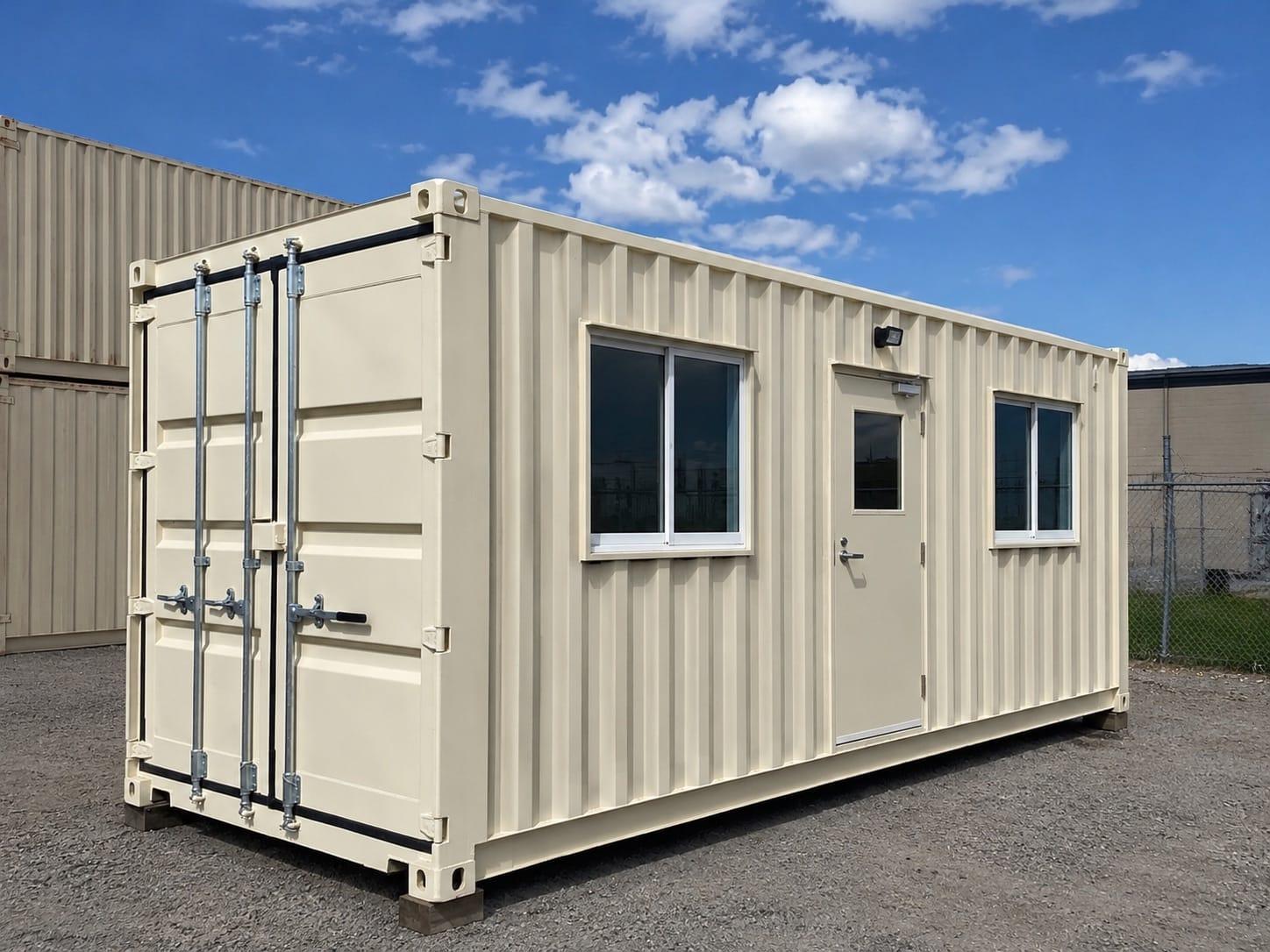
Custom Solutions
Custom container solutions, built in Kamloops
Custom containers for work and for living: site offices, workshops, farm storage, cold storage, pop-up shops, bunkies and turnkey container homes — designed around your project, built in our own yard and delivered anywhere in BC. Insulated site offices from $14,600 CAD; bunkies and modular homes are quoted per project.
Popular here: Container Offices — Insulated, wired 20' offices that replace the rented trailer — and move to the next project with you.