
Maintenance
Shipping Container Floors in BC
Every other surface on a sea can is steel. The floor is treated plywood, and it is the part buyers ask us about most once the container is on the ground.

Short answer: for dry storage, leave the floor alone. Clean it, keep water off it, and it will outlast most of what you put on it. For anything you will stand in daily — a workshop, an office, a shop, a space with kids, pets or food in it — seal it or cover it before you move in. Full replacement is a real option, but it is the last one on the list, not the first.
Container floors get asked about more than any other single component, and for good reason. It is the only part of the box that is not steel, it is the part that has spent years under a forklift, and it is the part people are standing on while they wonder what it was treated with. Here is the honest version of all of it.
What is actually under your feet
A standard shipping container floor is a deck of marine-grade plywood roughly 1 1/8 inches (28 mm) thick, screwed down to a row of steel cross-members that run side to side under the container about a foot apart. Those cross-members are welded to the two long bottom rails, and the whole assembly — steel frame plus plywood deck — is what carries the load.
The plywood itself is not ordinary construction sheathing. Container decks are traditionally built from dense tropical hardwood plywood, usually apitong or keruing, with a lot of thin plies and very little void. Newer units increasingly use bamboo or a bamboo-hardwood composite, which is why a 1-trip container often has a paler, harder-looking floor than a fifteen-year-old unit. Both are engineered to take a loaded forklift driving down the middle of the container, which is a far harder service life than a garage floor ever sees.
People worry the floor is weak because it is wood, and it is close to the opposite. A container deck will carry pallet racking, a lathe, a welder, a quad or a pallet jack without complaint. What it does not tolerate is standing water and neglect.
The treated-wood question, answered plainly
Container floor plywood is treated with insecticide and fungicide at the factory, and this is a quarantine requirement rather than a scandal: a container that picks up wood-boring insects in one country unloads them in another, so the deck is treated so it cannot become a transport route for pests. Older containers saw a range of chemistries over the decades; more recent production generally uses permethrin-type products, the same broad family used in household and agricultural insect control.
What to do with that information depends entirely on the use:
- Dry storage, equipment, tools, seasonal gear. No action needed. The treatment is bound into a sealed hardwood deck and you are not in contact with it.
- Workshop, office, studio, anything occupied. Seal or cover the floor. It is cheap while the container is empty and effectively impossible once your bench is bolted down.
- Food, feed, livestock, kids, pets, or a habitable build. Cover it properly, or replace the deck outright. If a project needs stamped drawings anyway, the floor spec is worth putting in front of the designer.
- Never dry-sand a container floor. Sanding is the one thing that turns a bound-in treatment into airborne dust. If a floor needs to come flat, plane it wet or overlay it instead.
A 1-trip container sidesteps most of this conversation. The deck is new, unstained, and has never had a leaking drum on it, which is one of several reasons the newest grades cost what they do — our guide to container condition grades in BC walks through how grade and floor condition track each other.
Seal, cover, patch or replace
Four options, in ascending order of cost and effort. Most people need the first or the second.
| Approach | What it involves | Best for |
|---|---|---|
| Clean and seal | Sweep, degrease, let it dry, then two coats of floor enamel, garage-floor paint or epoxy | Storage you want to keep clean; a shop floor on a budget; sealing in the factory treatment |
| Overlay | Screw down 1/4 to 1/2 inch plywood over the original deck, then vinyl plank, sheet vinyl, rubber matting or coin flooring | Offices, workshops, gyms, anything occupied — the most common choice by a wide margin |
| Patch panels | Cut out the damaged bay between two cross-members and fasten in a new piece of the same thickness | A localized soft spot, gouge or burn in an otherwise sound floor |
| Full replacement | Unbolt and lift out the whole deck, treat any surface rust on the cross-members, install new sheets | A genuinely failed floor, a food or habitable use, or a container going to a very long service life |
| Steel plate | Diamond or checker plate laid over the plywood, usually in the traffic lane only | Tracked equipment, drum storage, heavy repeated point loads |
If you are insulating the container anyway, sequence matters: floor work comes before wall and ceiling framing, not after. The subfloor build-up also eats headroom, which is one more argument for buying the taller unit — see how to insulate a shipping container in BC for how much height a finished interior actually costs you.
Do the floor while the container is empty
Sealing or overlaying a bare 20 ft deck is an afternoon and a few hundred dollars in material. The same job after the shelving, the bench and three years of contents have gone in is a weekend of moving everything twice. Decide before delivery day, not after.
How to inspect a floor before you buy
Floor condition is one of the few things about a used container you can assess in five minutes, and it tells you a lot about how the unit was treated. When you are walking a container in the yard:
- Walk the whole length. Bounce your weight down the centre line and along both edges. A sound deck feels solid everywhere. Any sponginess means water has been sitting there.
- Close the doors and look up and down. Daylight through the roof or the seams tells you where water has been landing. Daylight through the floor is rare but decisive.
- Look for stains and their shape. A dark ring is a leak. A long dark streak is a spill. Oil or chemical staining that has soaked in cannot be sanded out and should push you to an overlay or a different container.
- Check the edges and the door sill. The perimeter is where rot starts, because that is where wind-driven rain gets in past a tired door gasket.
- Look underneath. Get low and check the cross-members and the underside of the deck. Surface rust on the steel is normal; flaking, scaling rust and swollen plywood edges are not.
- Check the fasteners. Screws standing proud of the deck are a trip hazard and usually mean the plywood beneath them has softened. Backing them out and driving new self-tapping fasteners is a quick fix.
Keeping a floor alive in a BC climate
Almost every failed container floor we see failed for the same reason: water got in and stayed. Coastal sites do it with rain and standing damp, Interior sites do it with snowmelt and the freeze-thaw cycle, and both do it with condensation — the warm-day, cold-night cycle that puts a film of moisture on the inside of the steel, which then runs down the walls and pools at the edge of the deck.
Four habits handle nearly all of it. Set the container on a level, well-drained pad so water runs away from it rather than under it, and keep it up off dirt on blocks so air moves beneath the cross-members. Keep the door gaskets clean and lubricated so they actually seal. Ventilate, or use desiccant, in any container closed up for long stretches. And do not let grass and brush grow up against the bottom rail — vegetation holds moisture against the exact steel that is holding your floor up, and it is the most common avoidable cause of cross-member rust we see on BC acreages. Our container maintenance guide covers the seasonal routine, and none of it takes more than an hour a year.
Getting the right floor for the job in BC
If the container is for storage, a used unit with a clean, solid deck is all you need, and grade is what you should be shopping on. If it is going to be a shop or an office, buy the best floor you can and plan the overlay into the build from the start. We do floor sealing, overlays, patch work and full deck replacement as part of our container modification work, which is usually cheaper and far faster done in our yard before delivery than done on site afterward.
Floors also come up differently depending on where the container lands. On the wet coast and through the Fraser Valley the question is drainage and door seals. Around Prince George it is snowmelt and equipment traffic. In Kamloops and the dry Interior, decks last a long time and the real risk is the one spring the pad sat wet. Either way, the fastest way to settle it is to look at the actual unit — browse our current inventory and the full product range, and we will describe the floor in any container on the list before you commit to it.
Custom Solutions
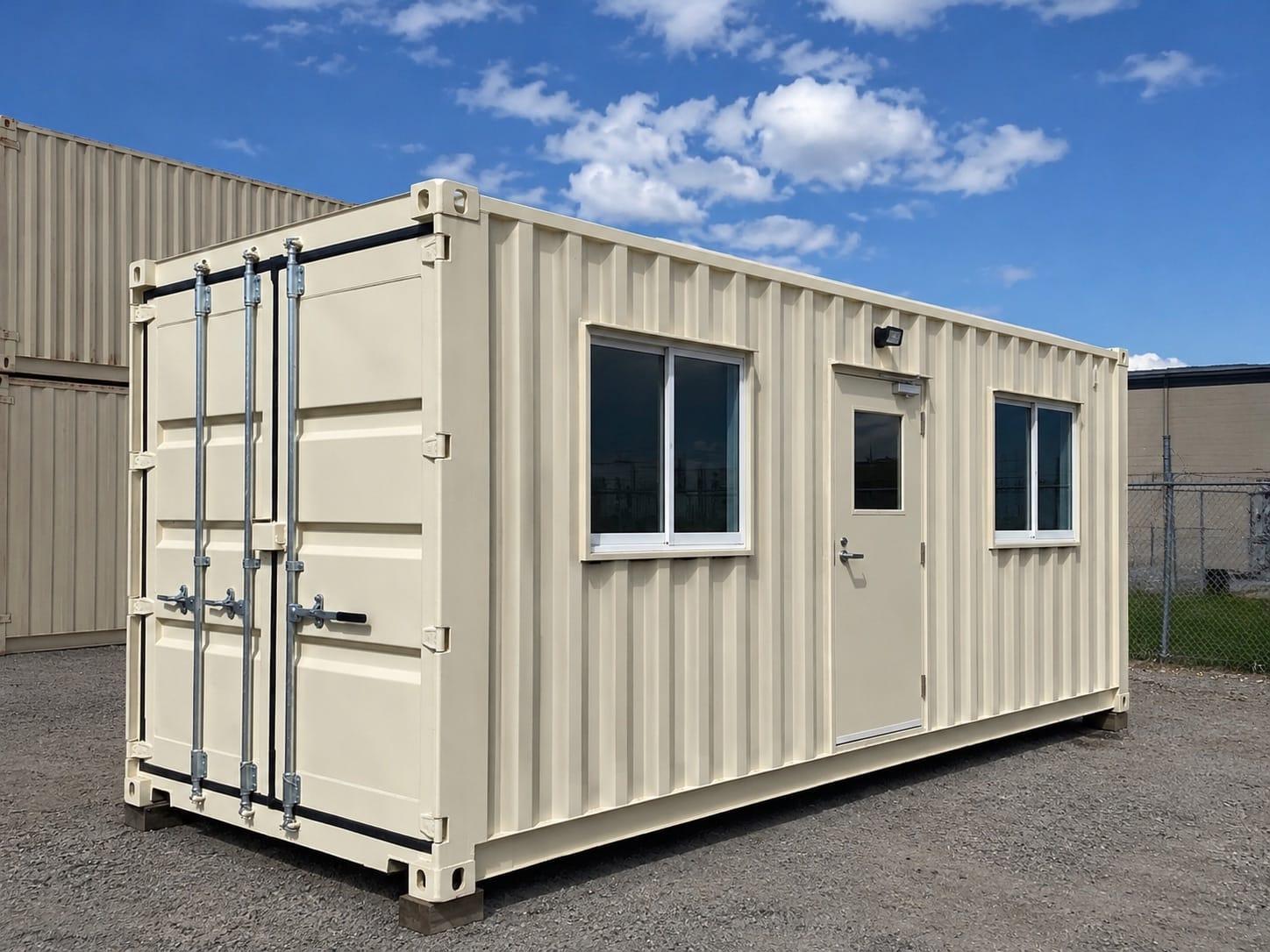
Custom container solutions, built in Kamloops
Custom containers for work and for living: site offices, workshops, farm storage, cold storage, pop-up shops, bunkies and turnkey container homes — designed around your project, built in our own yard and delivered anywhere in BC. Insulated site offices from $12,350 CAD; bunkies and modular homes are quoted per project.